
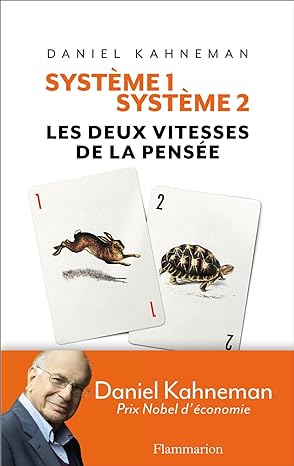
Thinking, Fast and Slow: The book that revolutionizes our understanding of thought
A fundamental work by Daniel Kahneman, Nobel Prize winner in economics
Have you ever made a decision you later regretted, wondering how you could have been so irrational? Have you ever observed unintentional discriminatory practices in your organization, despite everyone’s good will? “Thinking, Fast and Slow” by Daniel Kahneman offers fascinating answers to these universal questions and provides essential keys to building more inclusive and fairer professional environments.
Published in 2011 and translated into French in 2012, this book synthesizes more than forty years of research in cognitive psychology and behavioral economics. Daniel Kahneman, an Israeli-American psychologist and economist, received the Nobel Prize in economics in 2002 for his work on decision-making under uncertainty. This work has become a worldwide reference, translated into more than 40 languages.
The two systems of thought: a revelation
The book’s central concept rests on the existence of two modes of operation of our mind:
System 1 corresponds to fast, intuitive and automatic thinking. It is what allows us to instantly recognize a familiar face, understand simple sentences, or react to danger. It functions effortlessly and unconsciously, drawing on our past experiences and emotions.
System 2 represents slow, deliberate and analytical thinking. This is the mode we activate when solving a complex mathematical problem, comparing products before a major purchase, or learning a new skill. It requires concentration and mental energy.
Why is this book so important?
Kahneman brilliantly demonstrates that System 1, although extremely useful in our daily lives, is also the source of numerous errors of judgment. He exposes us to cognitive biases, those mental shortcuts that sometimes make us make bad decisions. In a professional context, these biases can, for example, lead to unintentional exclusions in recruitment or hinder collective innovation.
Among the most fascinating biases explored in the book:
The anchoring effect: our tendency to rely excessively on the first piece of information received, even if it is not relevant. For example, during a negotiation, the first price announced considerably influences the rest of the discussions.
The illusion of validity: our excessive confidence in our judgments, even when the evidence is insufficient. We tend to create coherent stories from limited information.
Loss aversion: we feel the pain of a loss about twice as intensely as the pleasure of an equivalent gain. This phenomenon explains why we sometimes make irrational decisions to avoid losses.
The availability effect: we overestimate the probability of events that come easily to mind, often because they are recent or emotionally striking.
An accessible book despite its depth
One of the great strengths of this work is its accessibility. Kahneman does not merely present abstract theories. He illustrates each concept with concrete experiments, personal anecdotes and everyday examples. The reader is constantly invited to test their own intuitions through small exercises and puzzles.
The writing style is clear and engaging, even when addressing complex subjects. Kahneman also shares the limitations of his research and the debates within the scientific community, which reinforces the credibility of his argument.
Practical applications in your life
Reading “Thinking, Fast and Slow” transforms our view of our own decision-making processes. Here are some areas where the book’s lessons can be applied:
In the professional world, understanding cognitive biases helps improve strategic decision-making, avoid recruitment errors based on first impressions, and better analyze risks. This understanding is particularly important in a professional inclusion approach, where it is essential to recognize our unconscious biases related to age, origin or gender. This knowledge is particularly valuable in shared governance approaches, where the quality of collective decisions depends on each person’s ability to identify their own biases.
In personal life, this knowledge helps us step back from our impulsive purchases, better evaluate the information we receive, and understand why we sometimes have disproportionate reactions. It is also a valuable tool in any personal development and coaching approach, allowing for better self-knowledge.
In investment and finance, Kahneman’s concepts shed light on why we sometimes make counterproductive financial decisions, influenced by fear or the euphoria of the moment.
In learning organizations, understanding these cognitive mechanisms becomes essential for implementing effective agile methods and fostering a genuine feedback culture. Teams that integrate this knowledge are better equipped to avoid confirmation bias in their retrospectives and make more informed decisions during their planning.
Kahneman’s lessons in service of inclusion and the collective
At 1Clusif, we are particularly sensitive to the connections between Kahneman’s work and our values of inclusion and collective building. This book offers essential keys to understanding and combating mechanisms of exclusion.
Cognitive biases and unconscious discrimination
System 1, with its automatic shortcuts, is often at the root of unintentional discrimination in recruitment and management. The halo effect, for example, makes us judge a person overall based on a single positive or negative characteristic. Understanding these mechanisms is the first step toward building genuinely inclusive organizations, where equality by nature is not just a principle but a daily reality.
The biases related to age, origin, sex or nationality that we fight at 1Clusif often have their source in the automatic functioning of System 1. Becoming aware of these biases allows us to activate our System 2 for more thoughtful and equitable decisions.
Collective intelligence and cognitive diversity
One of the major lessons of Kahneman’s book is that we all have blind spots in our thinking. This is precisely where collective intelligence takes on its full meaning. By confronting our respective System 1s, by accepting that everyone has their own biases, we together create richer and fairer thinking.
The co-development and participative management practices that we promote precisely allow us to compensate for the individual weaknesses of our System 1 with the strength of the collective. Each participant brings their unique perspective and helps others break free from their automatic patterns of thought.
Learning and transmission
Kahneman shows us that genuine learning often requires slowing down, activating our System 2, and questioning our intuitions. This approach resonates deeply with our commitment to transmission and training, notably in coding proficiency and emerging technologies.
Training someone is not just about transmitting technical skills to them; it is also about helping them develop their critical thinking, recognize their own biases, and step back when facing complex situations. The support we offer integrates this dimension of developing reflective thought.
Management and responsible leadership
For companies engaged in transformations toward more humanist governances, understanding the two systems of thought is crucial. A responsible leader must know when to trust their intuition (System 1) and when to take the time for in-depth analysis (System 2).
The sociocratic or holacracy approach rests partly on this idea: iterate quickly (System 1) while keeping moments for retrospective and analysis (System 2). It is this balance that allows for the creation of genuinely adaptable organizations.
Innovation and creativity
Entrepreneurial spirit and creativity, founding values of 1Clusif, sometimes require stepping off the beaten path of System 1. Disruptive innovations, whether blockchains, artificial intelligence or new financial models, require activating our slow thinking to question the obvious.
The open source culture and hacker mindset that we champion are precisely approaches that foster this critical and creative thinking, in opposition to automatic reflexes and ready-made solutions.
Who is this book for?
“Thinking, Fast and Slow” is addressed to a wide audience. Whether you are a student, professional, entrepreneur, teacher or simply curious about how the human mind works, this book will bring you enriching perspectives.
Professionals in marketing, finance, management and healthcare will find valuable tools for understanding human behavior. Psychology and personal development enthusiasts will discover a solid scientific basis for improving their self-knowledge. For trainers and coaches, it is a major asset in any approach to transmitting knowledge and supporting change.
The book’s strong points
The scientific rigor is remarkable. Every claim is based on decades of experimental research. Kahneman abundantly cites his sources and honestly presents the controversies.
The pedagogical approach makes for captivating reading. The chapters are short and structured, allowing for progressive reading.
The universal scope of the concepts presented means that everyone can recognize themselves in the examples and apply the lessons to their own life.
A few limitations to note
The book runs to about 550 pages in its French version, which may seem intimidating. Some chapters, notably those on statistics and probabilities, require sustained attention.
Furthermore, some research cited in the work has since been the subject of debate within the scientific community, particularly in the context of the “replication crisis” in psychology. This does not diminish the overall value of the work, but invites a critical reading.
Our verdict
“Thinking, Fast and Slow” is an indispensable book for anyone interested in understanding human beings and wishing to build a more inclusive and fairer professional world. It does not offer miracle solutions or ready-made recipes, but offers something far more valuable: a better understanding of our thought mechanisms and tools to combat our biases.
For actors of inclusion and organizational change, this book is a valuable resource. It reminds us that equality and inclusion are not decreed; they are built by becoming aware of our automatic patterns of thought and creating environments that foster collective reflection.
After closing this book, you will no longer look at your decisions the same way. You will develop a caring vigilance toward your own judgments, a better understanding of others’ behavior, and above all, you will have concrete tools to build genuinely adaptable and inclusive organizations.
It is an investment of time that is well worth it. As Kahneman himself says: “The goal is not to disable System 1, but to recognize the situations in which it can mislead us, and to activate System 2 when necessary.” A maxim that could perfectly apply to our collective mission at 1Clusif: building a professional world where everyone has their place, in full awareness.
Practical information
Original title: Thinking, Fast and Slow (2011) French title: Système 1 / Système 2 : Les deux vitesses de la pensée Author: Daniel Kahneman French publisher: Flammarion Number of pages: about 550 pages ISBN: 978-2081211636
Why this book resonates with 1Clusif’s values
At 1Clusif, we firmly believe that understanding thought mechanisms is essential for building more inclusive and adaptable organizations. Kahneman’s work reminds us that our decisions, even well-intentioned ones, can be influenced by unconscious biases that lead to exclusion.
By understanding how our System 1 works, we can better identify these biases in our recruitment, management and collaboration practices. This is an essential first step toward genuine equality by nature, one of our founding values.
Reading this book enriches our coaching practice and our organizational development approaches, giving us the keys to help individuals and organizations make better decisions, more conscious and more inclusive. It fits perfectly with our vision of a humanist company where every person is valued for their unique contribution.
This article is part of our “A bit of reading” section, where we explore works that help us better understand the world, build more inclusive organizations and develop our critical thinking.