
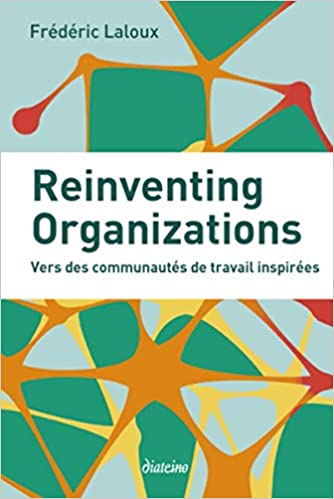
Reinventing Organizations: When organizational transformation meets inclusion
How can we transform our organizations so that they stop excluding and start revealing everyone’s potential? This question runs through Frédéric Laloux’s revolutionary book, “Reinventing Organizations,” published in 2014. More than a simple managerial manifesto, this work outlines the contours of a profound evolution in how we conceive collective work.
Beyond hierarchy: a systemic vision of change
Frédéric Laloux does not propose yet another managerial recipe. His approach, the fruit of an in-depth study of pioneering organizations around the world, reveals a recurring pattern: the most high-performing and most human structures share a holistic approach to management. They embody fundamental principles — consciousness, participation, evolution, authenticity and transparency — which resonate deeply with the challenges of inclusion and adaptability of our era.
This vision aligns with the conviction that equality by nature is not an abstract ideal, but a lever for performance. When an organization truly recognizes the intrinsic value of each person, it does not merely respect an ethical principle: it unleashes unsuspected collective capacities.
The opal organization: a living ecosystem rather than a machine
The concept of the opal organization constitutes the heart of Laloux’s proposal. These organizations are characterized by three major innovations:
Self-governance replaces the hierarchical pyramid with fluid structures where power circulates according to needs and skills. This decentralization is not an abandonment of authority, but an intelligent redistribution that places the decision as close as possible to the action.
Wholeness invites each person to show up in their entirety at work, without artificially compartmentalizing their professional and personal personality. This authenticity becomes a strength: it allows for creativity, innovation and genuine engagement.
Evolutionary purpose transforms the organization into an organism sensitive to its environment, capable of perceiving and responding to the weak signals of change. The organization ceases to be driven by the ego of its leaders to be guided by its deep mission.
These three pillars outline an organization whose capacity for adaptation becomes structural rather than exceptional. Faced with technological, climatic and social mutations, this organizational plasticity is no longer a luxury but a condition of survival.
From theory to practice: shared governances and collective intelligence
Laloux’s principles find concrete application in models of shared governance. These approaches — whether sociocracy or holacracy — materialize the vision of Reinventing Organizations in operational processes.
The decentralization of power as a lever for inclusion
Traditionally, concentrated power generates exclusions: exclusion of dissenting voices, exclusion of minority perspectives, exclusion of unconventional skills. By distributing decision-making authority, opal organizations mechanically create more inclusion. Each member of the collective can contribute to strategic decisions in their area of competence, regardless of their formal status.
This decentralization does not mean chaos. It is accompanied by a clarification of roles, responsibilities and decision-making processes. Transparency becomes the cement that allows this distribution of power to function without fragmenting into isolated silos.
The culture of trust as a foundation
Laloux insists on a fundamental prerequisite: trust. Without it, no transformation toward an opal organization is possible. This trust cannot be decreed; it is cultivated through daily practices of transparency, responsibility and kindness.
Collective intelligence emerges naturally in these environments of trust. When people feel psychologically safe, they dare to take risks, experiment, fail and learn. This cycle of collective learning directly feeds the organization’s Adaptation Coefficient.
Shared leadership: from authority to influence
In an opal organization, leadership is not the preserve of a managerial elite. It circulates dynamically according to situations. A person can be a leader on a specific project, then a contributor on another. This fluidity of roles cultivates an entrepreneurial spirit: everyone learns to take initiative, mobilize resources, inspire collaboration.
This distributed leadership is also a powerful vector of transmission. Knowledge does not remain captive in a managerial ivory tower; it circulates horizontally throughout the organization, continually enriching the collective capital of skills.
Adaptation Coefficient and opal organizations: a natural convergence
The link between Laloux’s opal organizations and the concept of the Adaptation Coefficient is not coincidental. These organizations embody in their very structure the four dimensions of organizational adaptability:
The cognitive dimension is expressed through their ability to learn collectively, integrate multiple perspectives and question their own paradigms. The absence of rigid hierarchy facilitates the circulation of ideas and constructive questioning.
The behavioral dimension manifests itself in their operational agility. These organizations continually experiment, adjust their practices and do not hesitate to abandon what no longer works, even if it has long been considered a given.
The emotional dimension finds its expression in the culture of wholeness that allows vulnerability and transforms failure into learning. Collective resilience becomes natural when people can express their authentic emotions.
The social dimension is embodied in practices of fluid collaboration and transparent communication. Opal organizations excel at rapidly reconfiguring their teams according to emerging needs.
In this sense, “Reinventing Organizations” does not merely describe alternative organizational models. It maps the structural characteristics of organizations endowed with a high Adaptation Coefficient.
Limitations and open questions
While recognizing the inspiring power of Laloux’s book, it is important to question its blind spots. Does the transition to an opal organization require certain prerequisites? Can all organizations take this path, or do certain contexts — heavily regulated, highly technical, marked by crises — resist this transformation?
Furthermore, the question of collective responsibility deserves in-depth examination. How can individual and collective responsibility be articulated without diluting accountability? How can situations be managed where decision-making by consent leads to mediocre compromises rather than excellent solutions?
These questions do not diminish the value of “Reinventing Organizations.” On the contrary, they invite a critical and contextualized appropriation of its teachings.
Toward inclusive and adaptable organizations
Laloux’s central message transcends managerial debates: our organizations can become spaces of fulfillment and collective value creation if we accept questioning our assumptions about power, control and human nature.
This vision resonates particularly in a context where exclusions — technological, professional, financial — are multiplying. Organizations that manage to combine economic performance and genuine inclusion, operational efficiency and respect for human wholeness, stability and adaptability, will not merely survive the turbulence of the 21st century. They will help shape a more just and more resilient society.
“Reinventing Organizations” is not an instruction manual. It is an invitation to courage: the courage to question our certainties, to experiment with other paths, to accept the vulnerability inherent in any profound transformation. For entrepreneurs and leaders who aspire to build lasting and human collectives, this book offers not definitive answers, but fertile questions and avenues of exploration that continually nourish reflection on what it means to create together, differently.