
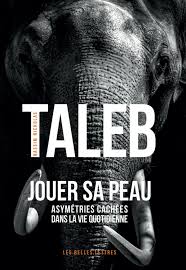
When responsibility becomes the heart of action: “Skin in the Game” by Nassim Nicholas Taleb
In a world where decision-makers rarely take the risks they impose on others, where consultants theorize without experimenting, and where experts multiply without ever putting their credibility on the line, Nassim Nicholas Taleb offers us, with Skin in the Game, a philosophical essay as unsettling as it is essential.
Published in 2018, following on from The Black Swan, this book examines a fundamental asymmetry in our societies: the one that separates those who make decisions from those who bear the consequences. For Taleb, this rift is the root of many organizational, social and economic dysfunctions.
The asymmetry of risk: diagnosing a sick system
The principle is simple but radical: anyone who influences other people’s lives should share the risks of their decisions. A banker who speculates with other people’s money without risking their own, a politician who votes for a war without sending their own children to the front, a consultant who sells strategies they never apply themselves… Taleb sheds light on these hidden asymmetries that corrode our institutions.
This vision resonates deeply with the values carried in our organizations: responsibility can only be authentic when it engages the person who decides. This is not an abstract moral concept, but a concrete mechanism that ensures economic and social actors bear the cost of their mistakes.
“Put your skin in the game, start a business,” writes Taleb. This advice, far from anecdotal, reminds us that entrepreneurship may be one of the last forms of authentic commitment in our society.
From theory to practice: the wisdom of experience
One of the major contributions of the book is its sharp critique of what Taleb calls “Intellectuals Yet Idiots” (IYI): educated, credentialed people who are dangerously disconnected from reality. For the author, knowledge acquired through direct experience, by putting your own skin in the game, far surpasses that of abstract reasoning.
This distinction between theoretical knowledge and practical knowledge echoes the culture of the hacker mindset and open source: learning by doing, iterating quickly, accepting failure as a source of learning. It is precisely in this zone of discomfort, where you truly risk something, that authentic understanding of the world is forged.
In the context of organizational adaptability, this approach takes on its full meaning. The behavioral dimension of the Adaptation Coefficient – this capacity to experiment, to abandon obsolete habits and to persevere despite obstacles – can only develop in an environment where failure is not merely tolerated, but owned and shared.
Entrepreneurship: the art of putting skin in the game
The entrepreneurial spirit finds in this essay a deep philosophical justification. The entrepreneur literally puts their skin in the game: their time, their capital, their reputation, sometimes their mental health. This exposure to risk is not a flaw in the system, but its greatest virtue.
Taleb goes further: only those who have something to lose can truly innovate. Authentic innovation is not born from brainstorming sessions in a meeting room, but from direct experimentation, with its stinging failures and unexpected victories. Agile methods, which encourage rapid iteration and continuous adaptation, perfectly embody this philosophy of “skin in the game.”
For organizations seeking to build lasting, resilient collectives, the message is clear: encourage your teams to take measured, but shared, risks. Create environments where experimentation is valued, where failure becomes a lever for evolution rather than grounds for punishment.
Inclusion and shared responsibility
A less obvious but fundamental aspect of Taleb’s work concerns authentic inclusion. When everyone puts their skin in the game within a collective, power asymmetries naturally shrink. No one can any longer simply give orders without bearing the consequences.
This vision aligns with the principles of shared governance: in an organization where everyone truly commits their responsibility, collaboration becomes a vital necessity rather than a pious wish. No one can hide behind the decisions of a distant board anymore.
Inclusion, from this perspective, cannot be decreed through charters or quotas. It emerges naturally from a system where every voice truly counts, where every actor shares the risks and benefits of the collective. It is the symmetry of risk that creates true equality.
On the courage of authenticity
Taleb affirms that “courage is the only virtue you cannot fake.” This maxim resonates with particular force in our era, saturated with virtuous communication and virtue signaling. It is not enough to proclaim your values: you must also embody them by taking real risks.
For those who carry out mentoring, transmission or organizational transformation projects, this principle is a valuable compass. We cannot authentically support others if we do not put our own skin in the game. The mentor who does not practice what they teach is merely a theory teacher.
Anti-fragile organizations: beyond resilience
One of the most powerful concepts developed by Taleb in his work (notably in Antifragile) is that of organizations that don’t just withstand shocks, but feed on them to become stronger. These anti-fragile organizations share one characteristic: their actors put their skin in the game.
When a company systematically shields its leaders from the consequences of their decisions, it becomes fragile. Conversely, when leaders authentically bear the results – good or bad – of their choices, the organization develops a form of evolutionary robustness.
This vision directly aligns with research on the Adaptation Coefficient: the most adaptable organizations are not those that plan perfectly, but those that accept uncertainty, experiment quickly and learn from their failures. “Skin in the game” is the mechanism that enables this collective learning.
Limits and nuances: putting your skin in the game without sacrificing yourself
Despite the power of his intuitions, Taleb’s essay deserves some nuance. Putting your skin in the game does not mean sacrificing yourself blindly or taking excessive risks. The author himself insists on the notion of “via negativa”: it’s first about avoiding ruin, your own and that of others.
In our mentoring practices, this means creating bounded spaces for experimentation, where failure is possible but not catastrophic. It’s about building learning organizations where calculated risks can be taken without endangering the very existence of the collective.
An ethics for our time
Skin in the Game is not just a book about economics or risk management. It is a philosophical treatise on what it means to live authentically and responsibly in a complex and uncertain world.
For entrepreneurs, mentors, trainers and everyone building collective projects, this book offers an essential framework for reflection. It reminds us that responsibility cannot be delegated without also delegating risk. That transmission only makes sense when it is embodied in a real practice, exposed to the verdict of reality.
In our search for more inclusive, more adaptable and more human organizations, the principle of “skin in the game” is not just an ethical rule. It is a fundamental mechanism that guarantees the alignment between our words and our actions, between our intentions and their consequences.
As Taleb says: if you really want to change the world, don’t just talk about it. Put your skin in the game. Create. Experiment. Take ownership. And above all, share the risks with those your decisions affect.
Nassim Nicholas Taleb, Skin in the Game: Hidden Asymmetries in Daily Life, 2018.
This article is part of our A bit of reading series, where we explore the books that nourish our thinking on inclusion, adaptability and the building of lasting organizations.