
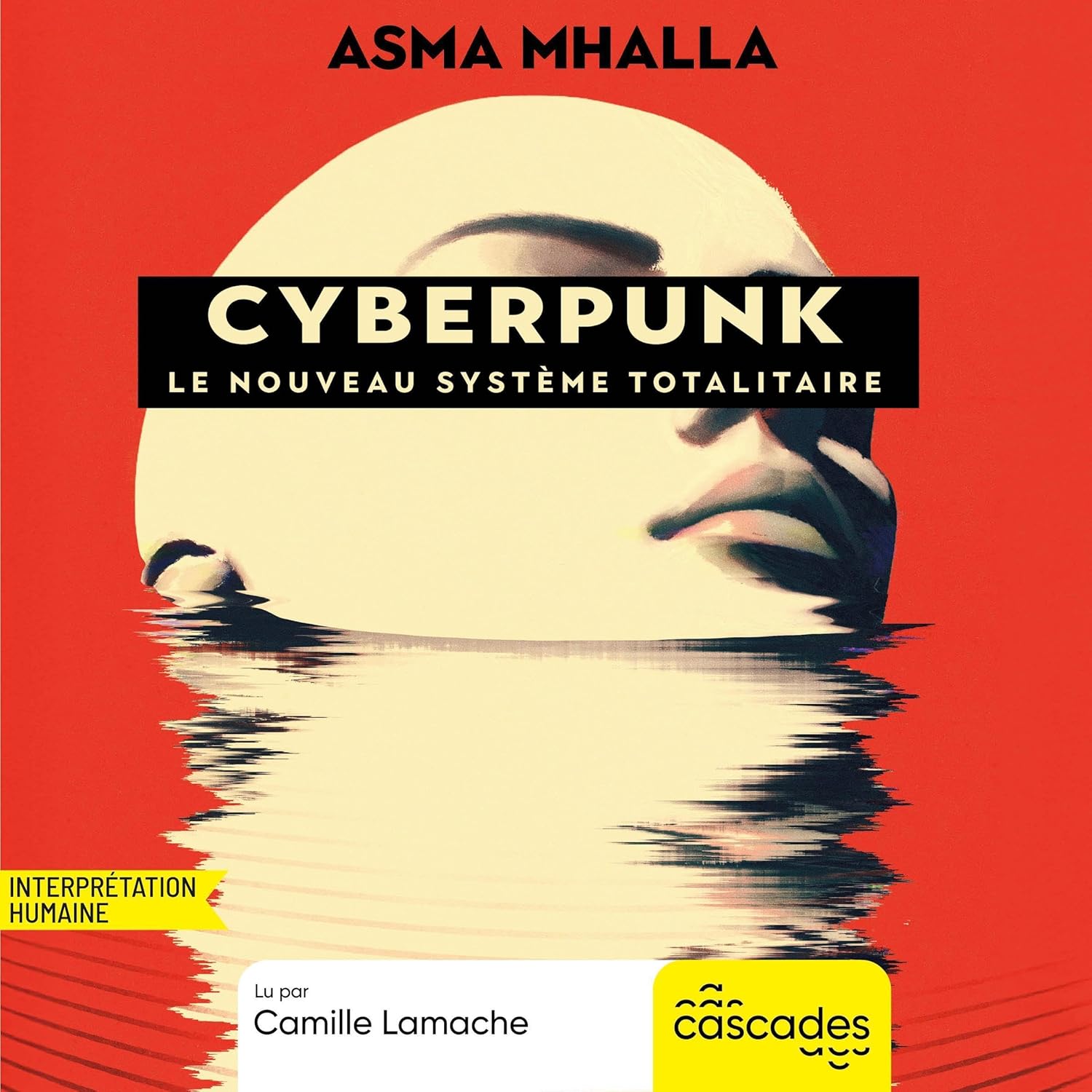
Cyberpunk: When dystopia becomes our reality – Decoding Asma Mhalla’s book
“The future is already here.” This phrase from William Gibson, a major figure of cyberpunk science fiction, resonates today with troubling accuracy. In her latest gut-punch essay, “Cyberpunk – Le nouveau système totalitaire” (“Cyberpunk – The new totalitarian system,” Éditions du Seuil, September 2025), political scientist Asma Mhalla confronts us with a disturbing truth: the dystopias we thought we could relegate to fiction have become our daily reality.
Asma Mhalla: An essential voice for thinking about the 21st century
Before diving into the twists and turns of this essential book, let’s pause on the person who wrote it. Asma Mhalla is no newcomer to public debate. A political scientist and essayist, she has established herself as one of the most lucid voices on the technopolitical issues of our time.
Coming from a family engaged in Tunisian politics, Asma Mhalla first worked in the world of finance before sick leave in 2016 led her to redirect toward her first loves: politics and the analysis of power relations. She then discovered the work of American theorist Bernard E. Harcourt on technosurveillance and became passionate about power dynamics in the digital age.
A lecturer at Columbia and Sciences Po, a columnist at Les Échos and host of the “CyberPouvoirs” show on France Inter, she published a first, widely noticed book in 2024, “Technopolitique: Comment la technologie fait de nous des soldats” (“Technopolitics: How Technology Turns Us Into Soldiers”). With “Cyberpunk,” she takes her argument to a new level of urgency and radicalism.
The Dileviathan: Anatomy of a new power
At the heart of Asma Mhalla’s analysis is a striking concept: the Dileviathan, a two-headed creature embodying the fusion between the state and tech giants. On one side, Donald Trump orchestrates the political spectacle and captures media attention. On the other, Elon Musk and the Silicon Valley oligarchs literally code our future through their platforms, their algorithms and their infrastructure.
This alliance is not anecdotal. It symbolizes the emergence of a new regime of power where governance is no longer exercised through traditional laws but through computer code. Technology megacorporations no longer merely influence politics: they become the very infrastructure of our societies.
From democracy to “fluxocracy”
Mhalla introduces another key concept: “fluxocracy,” a regime where everything is placed on the same level in a continuous flow of information. In this system, the distinction between true and false, between important and trivial, gradually fades away. The result? A systematic blurring of reference points that “makes the worst possible,” as illustrated by the rise of figures like Trump.
This cognitive saturation is not an accident: it is a strategy. “This century does not forbid you to think, it keeps you busy until you no longer know how,” she writes with chilling clarity.
Cognitive warfare: The new battlefield of the 21st century
Where “Cyberpunk” truly becomes alarming is in its description of what Mhalla calls cognitive warfare. This is no longer just a struggle for traditional political power, but a battle for the capture of our minds, our attention, our very capacity to think autonomously.
The weapons of this war are well known:
- Infinite scroll, which turns our dopamine into a controlled variable
- Recommendation algorithms, which create parallel reality bubbles
- Generalized surveillance, passed off as personalization
- Artificial intelligence, which promises to “augment” us but ultimately programs us
Geopolitical gaslighting
Mhalla goes further by describing a phenomenon she calls “geopolitical gaslighting”: this technique of psychological manipulation on a planetary scale, whereby the United States imposes its “regime of truth” on the rest of the world. Europe, according to her, plays the role of the “orphan continent,” suffering this grip without opposing it with an alternative vision.
Why this book resonates particularly with 1Clusif’s values
At 1Clusif, we work daily on digital inclusion, the transmission of technological knowledge, and the building of a fairer professional world. Asma Mhalla’s book resonates directly with our concerns.
Exclusion through technology
Mhalla describes how the techno-totalitarian system creates new forms of exclusion: cognitive exclusion for those who don’t master the codes, economic exclusion through the concentration of wealth in the hands of tech oligarchs, democratic exclusion through the bypassing of traditional institutions.
These exclusions echo the ones we fight: technological exclusions linked to a lack of training, professional exclusions linked to age, origin or gender. The difference? Mhalla shows us that these exclusions are not bugs in the system, but intrinsic features of the techno-authoritarian model being built.
Hacker culture as resistance
Particularly relevant for us, who value the hacker mindset and open-source culture: Mhalla calls for a form of resistance that involves mastering tools and understanding systems. She notably proposes “the art of tiny sabotage” and “the alliance of social-democratic hackers.”
This vision aligns with our conviction that inclusion requires the acquisition of technical skills, but also a critical awareness of what these technologies really are and the power relations they carry.
Cognitive survival manual: Paths of resistance
Fortunately, “Cyberpunk” is not just a warning book. Asma Mhalla proposes 13 concrete actions to counter what she calls the “dystopian monster.” Here are a few particularly illuminating ones:
1. Reinvest in the real
Faced with the total virtualization of our lives, Mhalla calls for “recreating the real”: physical encounters, spaces for discussion not mediated by screens, places where thought can unfold outside the algorithmic flow. “Reality becomes our pocket of resistance,” she affirms.
2. Strategic disconnection
Not a total and naive disconnection, but a chosen and considered disconnection to preserve our capacity for critical thinking. It is about regaining control of our attention, a resource that has become more precious than oil.
3. From the mass to the legion
Mhalla distinguishes the passive mass from the organized legion. “Those people [the fascists] are strong because we are weak, and we are weak because we are isolated.” Resistance therefore requires the creation of conscious, organized collectives.
4. Restoring the physical/bodily
In an increasingly dematerialized world, restoring the bodily dimension of existence becomes a political act. The body, sensory experience, direct connection become forms of resistance against algorithmic programming.
5. Cultivating critical thinking
More than ever, education in critical thinking is essential. It is not only about learning to code, but about understanding what code does to us, how it structures our thinking and our behaviors.
The urgency to act: Toward true digital sovereignty
What makes “Cyberpunk” so striking is its insistence on urgency. Mhalla does not describe a possible future but a present that is crystallizing. The shift is happening now, while we scroll, like, and interact with systems designed to capture us.
For an organization like 1Clusif, this raises crucial questions:
- How do we train people in technology while also training them in critical awareness of that technology?
- How do we promote digital inclusion without becoming complicit in the cognitive empire Mhalla describes?
- How do we use Silicon Valley’s tools to build alternatives that escape its logic?
Our powerlessness is an illusion
One of the book’s most powerful messages is that our sense of powerlessness is itself a construction. Mhalla reminds us that “consent is the foundation of power.” If we feel powerless in the face of tech giants, it is partly because the system is designed to produce that feeling.
She writes: “Our powerlessness is an illusion: consent as the foundation of power.” This sentence should resonate in every digital training, in every company undergoing transformation, in every space where the future of work and society is being thought through.
Conclusion: So now what do we do?
“Cyberpunk – Le nouveau système totalitaire” is not a comfortable book. It is an electric shock, a brutal wake-up call to a reality we often prefer to ignore. But it is precisely this uncomfortable clarity that makes it essential reading.
Asma Mhalla asks us: “Will we understand in time what is at stake?” The question is not rhetorical. It implies a responsibility: to educate ourselves, to understand, to act. For those of us who work in digital technology, who train people in these technologies, who support digital transformations, this responsibility is tenfold.
At 1Clusif, we believe in inclusion through technology. But after reading “Cyberpunk,” this conviction must be accompanied by a sharp awareness: digital inclusion cannot happen without digital emancipation. Training people in tools is not enough; we must also train them in a critical understanding of these tools and the systems of power they embody.
As Mhalla writes to conclude her book: “The only singularity we have left is that of standing upright, inwardly.”
It is standing upright, clear-eyed and organized that we must face this new world. And it is together, as a legion rather than a mass, that we can still defend our freedom.
“Cyberpunk – Le nouveau système totalitaire” Asma Mhalla Éditions du Seuil, September 2025
To go further
If this book struck a chord with you, we also recommend:
- “Technopolitique: Comment la technologie fait de nous des soldats” by Asma Mhalla (2024)
- The work of Bernard E. Harcourt on the surveillance society
- Listening to the “CyberPouvoirs” show on France Inter
- Reading the founding novels of the cyberpunk movement: “Neuromancer” by William Gibson, “Burning Chrome” by Bruce Sterling
And what about you, how do you perceive this transformation of our societies? What actions are you taking to preserve your autonomy of thought in the digital age?