
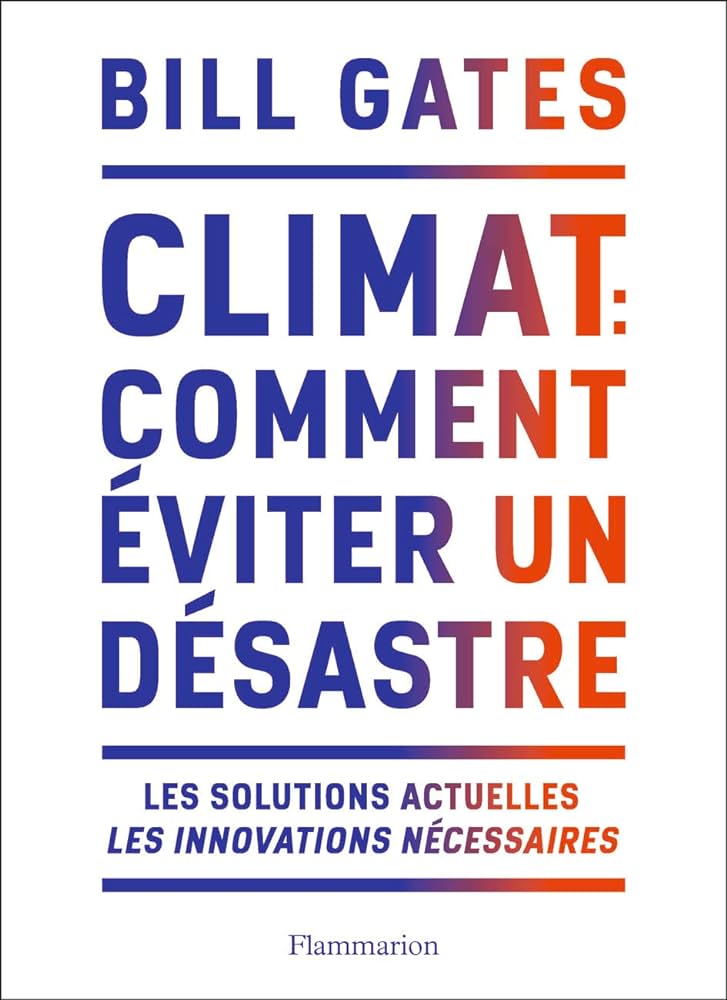
In a world where climate issues become more pressing every day, Bill Gates’s book “How to Avoid a Climate Disaster” stands as an essential compass for understanding and acting on the ecological emergency. Published in February 2021 by Flammarion (French edition), this accessible, pragmatic book proposes a concrete action plan for reaching net-zero carbon before it’s too late.
Who is Bill Gates and why this book?
Known as the co-founder of Microsoft and one of the richest men in the world, Bill Gates has gradually turned toward philanthropy and the great questions of our time. It was during his humanitarian missions in Africa, through the Bill & Melinda Gates Foundation, that he became aware of the crucial role of energy in development and of the climate emergency.
For more than a decade, he consulted experts in physics, chemistry, biology, engineering, political science and finance to understand the causes and effects of climate change. The result? A 405-page essay that avoids the pitfalls of paralyzing catastrophism to propose concrete, measurable solutions.
The goal: from 51 billion tons to zero
Bill Gates’s assessment is clear: humanity currently emits the equivalent of 51 billion tons of CO2 per year into the atmosphere. And here is the challenge: we must bring that number to zero by 2050 to avoid an irreversible climate catastrophe.
Why zero and not simply “reduce”? Because, as the author explains, nearly a fifth of the carbon dioxide emitted today will still be present in the atmosphere in ten thousand years. Every ton counts.
The 5 key sectors to transform
What distinguishes this book is its pedagogical clarity. Bill Gates breaks down global emissions into five major categories:
- Electricity (27%) – How to produce clean, reliable and affordable energy
- Manufacturing (31%) – From buildings to everyday objects, rethinking our production
- Agriculture (19%) – Feeding 8 billion people without destroying the planet
- Transportation (16%) – Decarbonizing our travel
- Heating and cooling (7%) – Regulating the temperature of our living spaces
Each sector is the subject of a detailed chapter where the author lays out existing solutions, necessary innovations and obstacles to overcome.
A pragmatic and innovative approach
Unlike many books on climate, Bill Gates adopts an engineer’s vision: he does not merely describe the problems, he quantifies the solutions. For example, he proposes a simple tool for evaluating any climate innovation: what percentage of the 51 billion tons can this technology eliminate?
This approach helps avoid false good ideas and focus on what actually works. The author also dismantles certain preconceived notions, such as the idea that our individual actions alone will be enough. Although important, they must be accompanied by major systemic transformations.
The proposed innovations and solutions
The book explores many exciting avenues:
- Alternative energies: next-generation nuclear, solar, wind
- Green fuels: hydrogen, advanced biofuels
- Low-carbon concrete and steel: essential materials to reinvent
- Carbon capture: technologies to remove CO2 from the atmosphere
- Electrification of transportation: beyond the simple electric car
- Geo-engineering: controversial solutions but worth considering
The role of each: citizens, businesses and governments
Bill Gates does not place responsibility solely on the shoulders of individuals. He details the role each actor must play:
Citizens can exert influence through their vote, their consumption and their local engagement.
Businesses must innovate, invest in green technologies and accept paying a temporary “green premium.”
Governments must create the regulatory and financial incentives necessary for the transition.
This inclusive, collaborative vision resonates particularly with the values carried by 1Clusif: collective action, shared responsibility and innovation in the service of the common good.
The book’s strong points
- Remarkable clarity: accessible even without a scientific background
- Quantified data: to understand the scale of the challenges
- A positive tone: far from catastrophism, the author believes in our capacity for innovation
- A global vision: every sector is covered comprehensively
- Concrete solutions: not just observations, but avenues for action
Criticisms and limits
Like any book, this one has its detractors. Some criticize Bill Gates for:
- A techno-optimistic bias that underestimates the need to change our lifestyles
- An approach that remains anchored in capitalism and growth
- Potential conflicts of interest linked to his investments
- Sometimes excessive optimism about our capacity for innovation
Nevertheless, the majority of readers and critics agree on the quality of the analysis and the relevance of the proposals.
Our opinion: a book you absolutely must read
In 1Clusif’s “A bit of reading” section, we look for books that shed light, inspire and provide the means to act. “How to Avoid a Climate Disaster” perfectly meets these criteria.
This book is particularly valuable because it offers something rare: a pragmatic and nuanced overall vision of the ecological transition. It is neither a political manifesto nor an indigestible scientific treatise, but a practical guide to understanding where we stand and where we need to go.
For the digital and management professionals we support at 1Clusif, this book reminds us that technological innovation, when guided by a humanist and inclusive vision, can be a formidable lever for positive transformation.
Who is this book for?
- Professionals who want to understand the climate issues in their sector
- Entrepreneurs looking for opportunities in the ecological transition
- Engaged citizens who want a clear vision to act effectively
- Decision-makers who need to integrate climate issues into their strategies
- The curious who want to understand without being overwhelmed by complexity
In conclusion: a call for collective action
“How to Avoid a Climate Disaster” reminds us that we have the means to avoid the worst, but that time is running out. By 2030, we must have put in place the regulatory tools and investments needed to reach carbon neutrality by 2050.
This book fits perfectly with the spirit of 1Clusif: that of an inclusive society where everyone, in their own place, can contribute to a better future. The ecological transition will not happen without inclusion, without the transmission of knowledge, and without collective responsibility.
As Bill Gates says: we need both a technological miracle and unprecedented political will. But if humanity managed to eradicate smallpox and put a man on the Moon, it can also solve the climate crisis.