
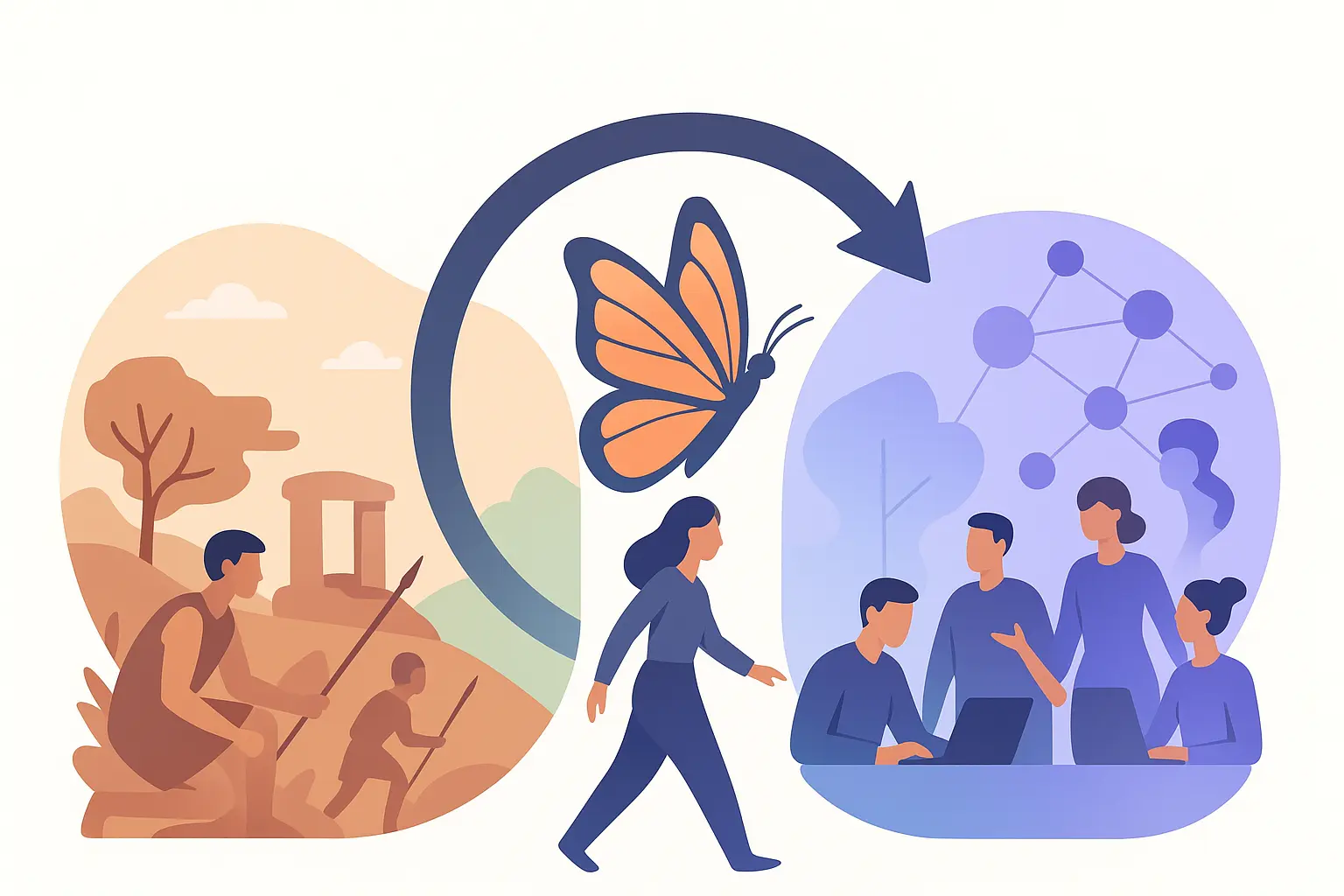
Adaptation through the ages: a survival coefficient for our organizations
In a world that is changing faster than ever, one question spans millennia: how do human societies survive upheaval? Faced with climate disruption, economic uncertainty, geopolitical tensions and technological upheaval, we are confronted with an age-old choice: resist or adapt. The history of civilizations teaches us that it is not strength that guarantees survival, but the ability to transform one’s practices in the face of the unforeseen.
The long history of human adaptation
Since the origins of humanity, adaptation has been our main strength. When our hunter-gatherer ancestors gradually domesticated plants and animals about 10,000 years ago, they did not know they were initiating one of the greatest transformations in human history. This Neolithic revolution was not a brutal break, but a series of gradual adaptations to climatic changes and the scarcity of game.
Human societies have developed countless adaptive strategies in the face of natural climate variability. They managed to settle in practically every climatic zone on the globe, including the most extreme. This remarkable plasticity is not the result of chance: it stems from an ability to observe, experiment, and pass on learnings from one generation to the next. It is precisely this value of transmission that 1Clusif places at the heart of its action.
When adaptation fails: the lessons of collapse
History is not just a succession of successes. It is also marked by collapses that challenge us. Geographer Jared Diamond, in his landmark book Collapse, analyzed the causes of the disappearance of several ancient societies. His conclusions are illuminating for our contemporary organizations.
Easter Island: when exploitation outpaces regeneration
Easter Island offers the most striking example of a society that unintentionally destroyed the resources it depended on. To erect and transport their monumental stone statues, the inhabitants gradually deforested the entire island. This deforestation triggered a cascade of ecological upheavals: soil erosion, declining agricultural yields, disappearance of marine resources. The population, estimated at 15,000 inhabitants at its peak, collapsed to about 2,000 people, plunging into destructive civil wars.
The troubling paradox: the inhabitants probably cut down the last tree knowing full well it was the last one. Why? Because social structures, religious values and the short-term interests of the elites prevented any questioning. It was this cultural rigidity that condemned the society, not resource depletion in itself.
The Greenland Vikings: the trap of cultural conservatism
The history of the Greenland Vikings illustrates the dangers of refusing to adapt even more strikingly. Arriving around the year 1000 during a favorable climatic period, these Norse settlers tried to reproduce their European way of life in a radically different environment.
For five centuries, they maintained their cattle-raising practices, a symbol of prestige in their culture of origin, despite an increasingly hostile climate. They ignored the hunting and fishing techniques of the Inuit, a local population perfectly adapted to the Arctic environment. They preferred to import religious ornaments and jewelry rather than vital resources. This disdain for local solutions and this attachment to the values of origin led them to the complete extinction of their colony around 1450.
A few kilometers away, the Inuit thrived. Same territory, same climate, radically different outcome. The decisive variable? Cultural flexibility and the ability to adjust one’s practices.
The factors of collapse according to Diamond
Jared Diamond identifies five combined factors that can lead a society to collapse:
Environmental damage, often caused unintentionally
Climate changes that disrupt baseline conditions
Hostile neighbors exerting external pressure
The loss of essential trading partners
The society’s inadequate responses, according to its own values
This last factor is crucial. It is not the environment that determines collapse, but a society’s ability – or inability – to transform its practices in the face of upheaval. Collapse is never inevitable: it is a choice, conscious or not.
Societies that knew how to adapt
Fortunately, history is not just made up of catastrophes. Some societies have shown a remarkable capacity for adaptation in the face of similar challenges.
Tokugawa-era Japan: adaptation through regulation
Japan from the 17th to the 19th century offers a fascinating example of a society that knew how to anticipate and manage a major ecological crisis. Faced with massive deforestation that threatened the supply of construction wood and fuel, the Tokugawa shogunate put in place, as early as 1666, some of the most sophisticated forest management policies of the time.
These measures included the systematic planting of trees, the rotation of logging, the protection of certain forest areas and strict regulations on the use of wood. At the same time, society adapted by developing wood-efficient construction techniques and systematically recycling materials.
Even more remarkably, Japan maintained a stable population of around 30 million inhabitants for more than a century, thereby avoiding the overpopulation that would have worsened the pressure on resources. This demographic stabilization was not imposed from above, but resulted from a social consensus on the need to live within the limits of the environment.
Radical transformation: Meiji and opening to the world
After more than two centuries of voluntary isolation (sakoku), Japan carried out, in the mid-19th century, one of the most spectacular transformations in history. Faced with Western pressure symbolized by the arrival of Commodore Perry in 1853, the country made a radical choice: rather than resisting industrial modernity by force, it would adopt and adapt it.
The Meiji era (1868-1912) saw Japan shift, within a few decades, from a feudal system to a modern industrial power. This transformation was not a mere imitation of the West, but a creative synthesis: the adoption of Western technologies and organizational methods while preserving and reinventing Japanese cultural values.
What makes this adaptation even more remarkable is that it built on existing structures. Confucianism, which advocated hierarchy and respect for authority, was reinterpreted to serve modernization. Merchants, traditionally looked down upon in the social hierarchy, became the drivers of economic development. Samurai retrained as officers, engineers and entrepreneurs.
This ability to transform without destroying, to modernize while preserving identity, illustrates a particularly high adaptation coefficient. Japan understood that it was not about choosing between tradition and modernity, but about creating a new synthesis.
What favors adaptation? A question of organizational culture
If some societies adapt better than others, it is rarely a question of material means or technical skills. It is fundamentally a question of culture: the values, beliefs, power structures and decision-making modes that shape an organization.
Cultural barriers to adaptation
Several cultural factors can block adaptation:
Conservatism of values: When a practice is sacralized or tied to the group’s identity, questioning it becomes psychologically and socially impossible. The Greenland Vikings could not abandon cattle raising without renouncing what they considered their Norwegian essence.
Cognitive capture of the elites: When those who make decisions are isolated from the consequences of their choices, they can maintain destructive practices. On Easter Island, the chiefs and priests who ordered the construction of the statues did not work directly in the depleted fields.
Collective denial: Faced with a complex and gradual threat, societies can minimize or ignore warning signals, especially when those signals call into question the dominant model. Our own relationship to climate change is a contemporary example.
Short-term conflicts of interest: Even when the need for adaptation is recognized, the immediate interests of certain groups can block the necessary transformations. Who agrees to lose privileges today for the common good of tomorrow?
Cultural facilitators of adaptation
Conversely, certain organizational cultures favor adaptation:
Tolerated experimentation: Societies that allow trial and error, that do not punish failure but treat it as learning, develop a greater capacity for innovation. This is what humanist governance seeks to establish in modern organizations.
Diversity of perspectives: When an organization values a plurality of viewpoints and allows different voices to be heard, it detects weak signals more quickly and imagines more creative solutions. Homogeneity is reassuring, but diversity adapts.
Transmission of knowledge: Societies that document their experiences, pass on their learnings and study their own history avoid repeating the same mistakes. This organizational memory is a valuable asset.
The ability to desacralize practices: The most resilient organizations distinguish what is essential (their deep values) from what is contingent (their methods). They know how to preserve the former while constantly adapting the latter.
Leadership by example: When leaders themselves embody the ability to question themselves, learn and evolve, they empower the whole organization to do the same.
The Adaptation Coefficient: a tool for thinking about our organizations
At 1Clusif, we develop the concept of the Adaptation Coefficient to assess an organization’s ability to cope with upheaval. This coefficient is not an absolute measure, but a framework for thinking that helps us identify levers and blockages.
How to assess an organization’s Adaptation Coefficient?
Several dimensions come into play:
The speed of signal detection: How quickly does the organization spot changes in its environment? Does it have effective listening and monitoring mechanisms?
The diversity of possible responses: When faced with a problem, does the organization consider several solutions, or does it limit itself to its usual recipes? Is its repertoire of action rich or limited?
The ability to experiment: Does the organization test its hypotheses on a small scale before generalizing? Does it accept failure as a source of learning? This is the very essence of agile methods.
The distribution of decision-making power: Can adaptation decisions emerge at all levels, or are they monopolized by an elite? The more power is distributed, the faster and more contextualized adaptation can be.
The strength of the collective: Does the organization function as a set of juxtaposed individuals, or as a true collective capable of collective intelligence? Is there a sense of belonging that transcends particular interests?
The balance between stability and movement: An organization that is too stable becomes rigid; an organization that is too fluid becomes scattered. The optimal Adaptation Coefficient combines stable values with flexible practices.
The fundamental paradox: the individual within the collective
One of the deepest lessons in the history of adaptation concerns the tension between the individual and the collective. The societies that survived are neither those that dissolved the individual into the group, nor those that exalted individualism to the point of destroying all social bonds.
As 1Clusif’s philosophy puts it: “To accept being diluted into a collective, we need to affirm our singularity, and we need that singularity to be recognized by the group.”
It is precisely this balance that Meiji-era Japan achieved: maintaining strong collective cohesion while freeing individual initiative. Entrepreneurs were able to innovate within a collective framework that gave meaning to their action. Modernization was not experienced as a betrayal of identity, but as its fulfillment under new conditions.
In our contemporary organizations, this balance is more crucial than ever. Faced with the challenges we confront, we cannot rely solely on directives from the top, any more than on disconnected individual initiatives. We need adaptable collectives where each member feels both recognized in their singularity and engaged in a shared endeavor.
Resist or adapt? A false dilemma
Faced with today’s challenges – climate disruption, economic uncertainty, geopolitical tensions, technological upheaval – it would be tempting to pose a binary choice: should we resist or adapt?
History teaches us that this opposition is misleading. Every successful adaptation contains an element of resistance: resistance to giving up, to the loss of identity, to forgetting what makes us human. The Greenland Vikings should have resisted the temptation to slavishly reproduce their Norwegian model. Meiji Japan resisted the dissolution of its identity into a pure copy of the West.
Conversely, any viable resistance requires adaptation. We do not effectively defend what is dear to us by remaining frozen in outdated forms. We defend it by reinventing it, by translating it into the new context.
The real issue, then, is not choosing between resistance and adaptation, but discerning what we must resist and what we must adapt to. Resist in our fundamental values – equality by nature, transmission, responsibility, entrepreneurial spirit, creativity, which animate 1Clusif. Adapt in our methods, our structures, our organizational practices.
What do these lessons tell us for our organizations today?
Contemporary acceleration makes adaptation more urgent and more complex. We no longer have generations to transform our practices. Upheavals overlap and interact in unprecedented ways. Climate change adds a new dimension: we must adapt to the consequences of our own actions while changing them.
Yet the fundamental principles remain:
Adaptation is not an option, it is a condition for survival. Our organizations, like the civilizations that preceded us, have no choice but to transform their practices in the face of a changing environment.
Cultural rigidity is more deadly than environmental constraint. It is not objective challenges that determine our fate, but our collective ability to face them with intelligence and creativity.
Adaptation is not a technical process, but a cultural one. It requires questioning our certainties, experimenting with new paths, accepting the discomfort of uncertainty.
The adaptive collective is stronger than the isolated individual, but it can only exist if each singularity is recognized and valued. This is the virtuous circle 1Clusif seeks to create.
The transmission of learnings is vital. We cannot afford to reinvent the wheel every generation. Documenting our experiences, sharing our failures as much as our successes, building a collective memory is a survival imperative.
Increasing our collective Adaptation Coefficient
The history of adaptation through the ages is not just an academic exercise. It is a mirror held up to our contemporary organizations. The Greenland Vikings and the inhabitants of Easter Island are not curiosities of the past: they are warnings. Meiji Japan and the societies that knew how to anticipate their ecological crises are not miraculous exceptions: they are models we can draw inspiration from.
The challenge ahead of us – building adaptable organizations in a world of accelerated change – is not new in nature. What is new is its urgency and its scale. We can no longer afford the slow trial-and-error learning that allowed past societies to evolve over several centuries.
This is why increasing our collective Adaptation Coefficient is not a luxury, but an existential necessity. This involves:
Creating spaces for experimentation where failure is not punished but becomes a source of learning
Fostering diversity of perspectives and trusting collective intelligence rather than solutions imposed from above
Valuing each singularity while building a strong and coherent collective
Systematically passing on our learnings to create a living organizational memory
Accepting that adaptation is neither linear nor predictable, but iterative and emergent
The societies that survived the great transitions were not necessarily the most powerful or the best equipped. They were the ones that knew how to desacralize their practices while preserving their values, that had the courage to question themselves before being forced to by catastrophe, that bet on collective intelligence rather than rigid authority.
At 1Clusif, we believe entrepreneurs have a crucial role to play in this great contemporary adaptation. Not as lone heroes, but as builders of collectives capable of transforming our organizations and, through them, our regions and our society.
Adaptation is not a project. It is a permanent process, an existential stance. The civilizations that understood this crossed millennia. The organizations that understand it will cross the century.
Join the 1Clusif movement
Are you an entrepreneur or a business leader? Are you questioning the adaptation of your organization and the building of a fulfilling collective? Join 1Clusif to exchange with other committed entrepreneurs and take action.