Beyond methodology: rethinking software development as a collective act
In the world of software development, two paradigms seem to naturally intertwine: Agile methods and shared governance. Their convergence is not the result of chance, but rather the coherent answer to a fundamental question our era asks us: how do we create software that truly serves its users, while building collectives that respect the intelligence and humanity of every contributor?
Modern software development is no longer just a series of technical instructions mechanically executed. It is a living, organic process, which requires a constant capacity for adjustment in the face of evolving requirements, changing technologies, and learning teams. This reality imposes a shift in posture: moving from a logic of vertical control to distributed intelligence, where every developer becomes co-responsible for collective success.
Agile Methods: A Philosophy of Permanent Adaptation
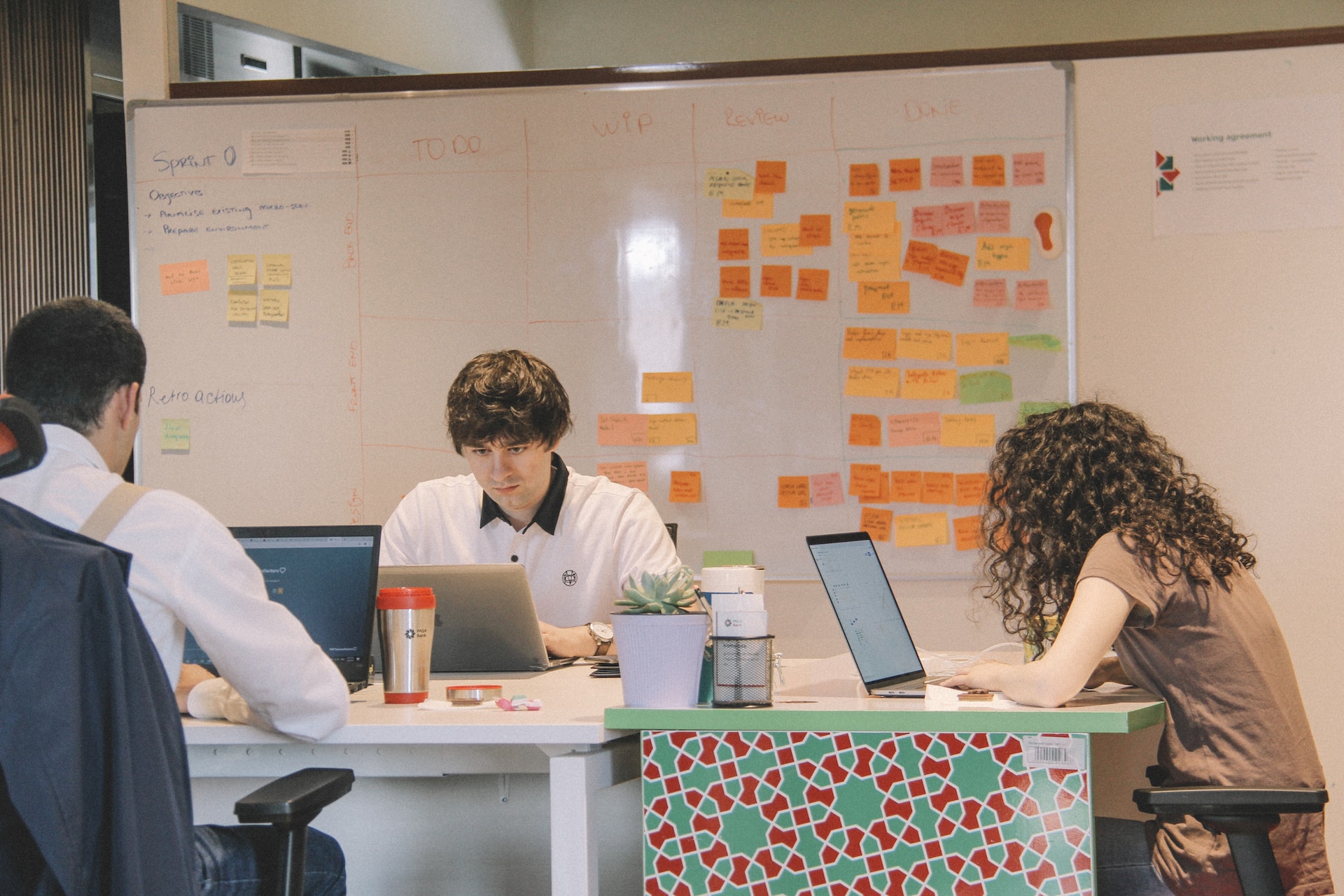
When seventeen developers gathered in Utah in 2001 to write the Agile Manifesto, they formalized a deep intuition: quality software is not born from rigid plans, but from authentic human interactions and a capacity to evolve with context. The manifesto’s four cardinal values still resonate today:
- Individuals and their interactions take precedence over processes and tools
- Working software is worth more than comprehensive documentation
- Customer collaboration surpasses contract negotiation
- Responding to change wins out over rigidly following a plan
These principles reveal a radically humanist vision of software development. They place relationship, responsiveness and pragmatism at the heart of technical practice. It is precisely these values that allow teams to develop what could be called a high Adaptation Coefficient.
The Adaptation Coefficient in Software Development
In a technical environment where frameworks evolve every six months, where user needs become clearer with each iteration, and where uncertainty is the only constant, the capacity to adapt is no longer an option, it is a vital skill.
A development team’s Adaptation Coefficient shows up in its four dimensions:
The cognitive dimension translates into the team’s ability to quickly learn new programming paradigms, to unlearn practices that have become obsolete, and to cultivate collective intelligence around the code. An adaptable developer does not simply master a language: they understand the underlying principles that allow them to navigate between different technical ecosystems.
The behavioral dimension shows up in daily practice: accepting refactoring as a necessity rather than a waste of time, experimenting with new architectures without fearing failure, adjusting one’s approach based on test and production feedback. Agile teams cultivate this behavioral flexibility by normalizing controlled experimentation.
The emotional dimension concerns resilience in the face of critical bugs in production, the ability to manage deadline pressure without sacrificing quality, and above all, the capacity to see every incident as a learning opportunity rather than a source of blame. In Continuous Integration and Continuous Delivery (CI/CD) environments, where deployments are frequent, this emotional stability becomes decisive.
The social dimension is expressed in collaboration between developers, designers, product owners and end users. It requires transparent communication, active listening, and the ability to co-construct solutions rather than defend technical positions out of pride.
Shared Governance: Redistributing Decision-Making Power
If Agile methods transform how code is produced, shared governance rethinks the power structure within development teams. Rather than a hierarchical pyramid where a project manager dictates direction, shared governance proposes a distribution of responsibilities based on skill, context and collective consent.
This model rests on several pillars:
Collective responsibility implies that the entire team owns the quality of the code, the architecture and the final product. No developer can hide behind an “I was just following orders.” Everyone becomes a guardian of technical coherence and delivered value.
Decision-making by consent replaces majority vote or hierarchical authority. A decision is only validated if no team member raises a fundamental objection to it. This process, inspired by sociocracy, forces minority voices to be heard and considerably enriches the quality of technical choices.
Radical transparency requires that information flow freely: code performance metrics, architecture decisions, user feedback, difficulties encountered. This openness creates trust and allows every team member to make informed decisions.
The Fertile Intersection: Agile and Shared Governance in the CI/CD Cycle
Continuous Integration and Continuous Delivery practices perfectly embody the symbiosis between Agile and shared governance. In a mature CI/CD pipeline, every code change is automatically tested, integrated and potentially deployed to production. This automation is not just technical, it is organizational.
CI/CD requires distributed trust: every developer must have the technical capacity and the decision-making autonomy to push code to production, while assuming collective responsibility for the system’s stability. This trust can only emerge in an environment of shared governance, where transparency and collaboration are established norms.
Agile retrospectives, an emblematic practice of Scrum, become essential moments of collective learning. They allow teams to analyze failed deployments, identify bottlenecks in the pipeline, and continuously adjust their practices. This permanent feedback loop feeds the team’s Adaptation Coefficient.
The Concrete Challenges of This Convergence
Jointly adopting Agile and shared governance in software development is not a smooth ride. Several tensions deserve to be named:
The temptation of false agility lurks in many organizations. They adopt Scrum rituals (daily standup, sprint planning, retrospectives) without embracing their spirit. The result? Teams that practice a “facade Agile” where the traditional hierarchy persists, masked behind trendy vocabulary. Without a real redistribution of decision-making power, agility remains superficial.
The difficulty of measuring value is another major challenge. In shared governance, how do you evaluate individual contribution when success is collective? How do you reward excellence without creating destructive competition? These questions require deeply rethinking evaluation and recognition systems.
The cost of the transition should not be underestimated. Training developers used to receiving detailed specifications to become active co-designers takes time, support, and a tolerance for error that not all organizational contexts allow.
Toward Learning Organizations: The Challenge of Inclusion
Beyond technical efficiency, the convergence between Agile and shared governance carries a deeper stake: that of inclusion in digital professions. By redistributing decision-making power and valuing diversity of perspectives, these approaches create environments where varied profiles can thrive.
A junior developer, in a truly agile and horizontal team, can question an architecture decision without fear of “disrespecting” seniority. A woman developer can propose an alternative approach without being systematically contradicted by male-dominance dynamics. A professional in career transition can bring their business expertise to enrich technical thinking.
This openness is not just ethical, it is strategic. Heterogeneous teams produce software that better serves the diversity of their users. They detect algorithmic bias more quickly, better anticipate edge cases, and design clearer interfaces.
Cultivating Collective Adaptability: A Few Concrete Practices
To develop a development team’s Adaptation Coefficient while applying Agile and shared governance, certain practices prove particularly effective:
Pair programming fosters horizontal knowledge transfer and dissolves individual ownership of code. It also helps normalize vulnerability: showing that you don’t know, asking for help, experimenting together.
“Blameless post-mortems” after every production incident create a culture where error becomes a source of collective learning rather than a pretext for finding culprits. This psychological safety is essential for innovation.
“Architecture decision records” (ADRs) document not only technical decisions, but also their context and the alternatives considered. They allow future team members to understand the reasoning behind existing code, thereby facilitating the continuous adaptation of the architecture.
Role rotations in Scrum teams (notably the Scrum Master role) allow everyone to experience different perspectives and develop a systemic understanding of how the collective functions.
From Software to Adaptable Collective
Agile methods and shared governance are not simple methodological tools to be applied mechanically. They embody a vision of software development where permanent adaptation, collective responsibility and respect for human intelligence form the foundation of lasting excellence.
In a world where technology cycles are accelerating, where uncertainty is becoming the norm, and where the complexity of systems is growing exponentially, only teams capable of cultivating their collective Adaptation Coefficient will be able to thrive. This requires moving beyond pre-established recipes to engage in a process of continuous learning, humble experimentation, and patient co-construction.