
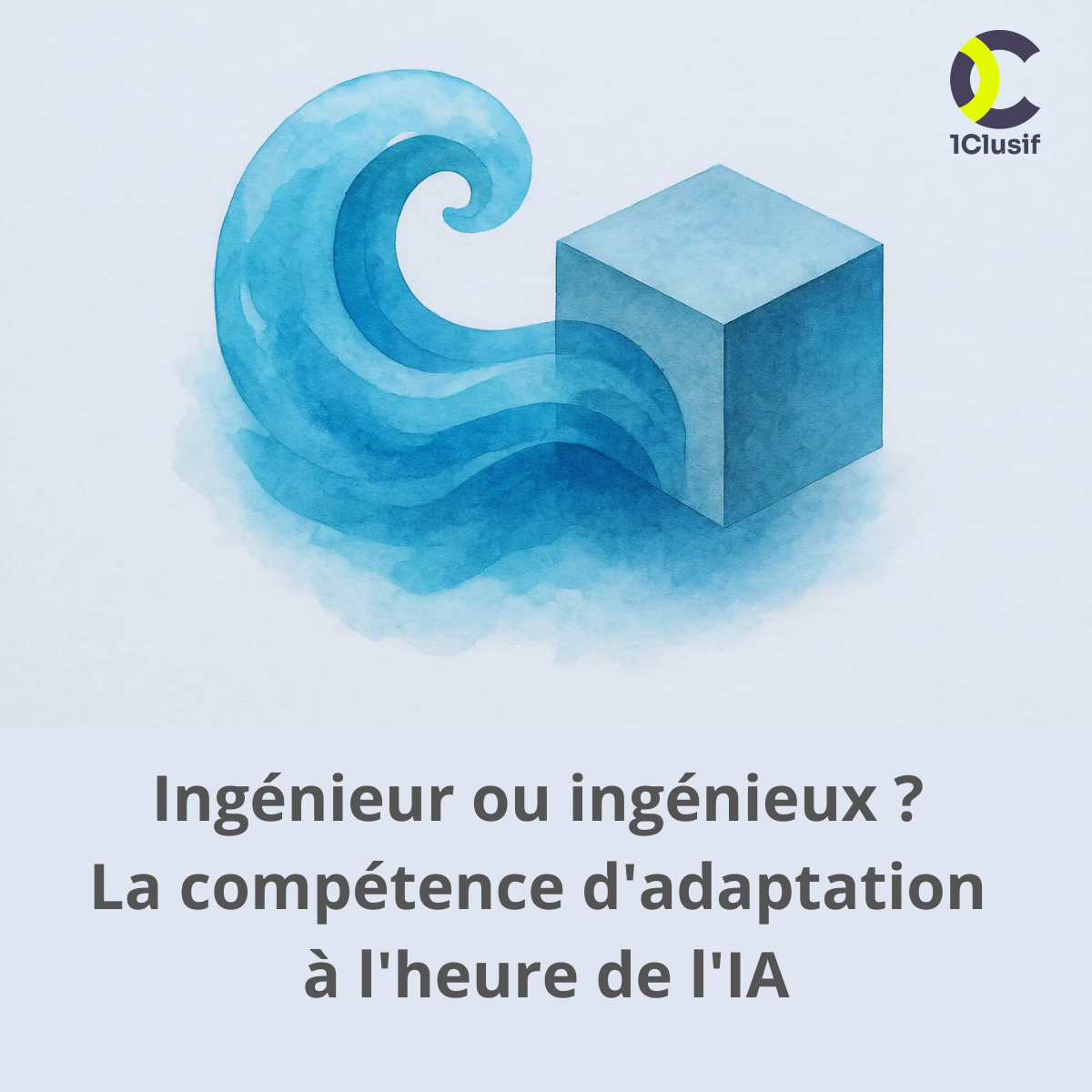
The development of artificial intelligence raises a question we often dodge: are we still valuing the right skills? Between ingenuity and adaptation, there is a strong link that our education systems still struggle to recognize. Yet, in an increasingly uncertain economic, climatic and geopolitical context, it is precisely this ability to find solutions amid the unexpected that distinguishes the individuals and organizations that hold up from those that collapse.
This is the topic we explored as part of Quotient A. Here is what that conversation revealed.
Engineer or ingenious: two very different stances toward reality
The engineer, in the classic sense of the term, has accumulated solid theoretical knowledge. Their training has taught them to analyze, model, formalize. That’s an undeniable strength. But this stance is often more oriented toward understanding than toward immediate action.
The ingenious person, on the other hand, is the resourceful one. The tinkerer. The one who solves a problem with whatever means are at hand, without waiting for the instruction manual. Their value isn’t in what they know, but in what they do with what they have.
In a world where the rules change overnight, this second stance becomes decisive. When tariffs suddenly increase by 30% in a sector, when a technology makes a key skill obsolete within a few months, the question isn’t “what did I learn?” It’s “what can I do, right now, with what I have?”
Ingenuity, a central skill of the Adaptation Coefficient
This is where the link with our research on the Adaptation Coefficient (AC) becomes clear. The AC measures an individual’s or an organization’s capacity to modify their behaviors, cognitions and emotions in response to environmental changes, while maintaining or improving their performance and well-being.
The ingenious person naturally has a high AC. Not because they’ve planned for everything, but because they’ve learned to work with the unexpected. They don’t just endure crises: they adapt. Better still, they aim for what we call happy adaptation, meaning a chosen adaptation, mobilizing emotional intelligence as much as reason.
This is not trivial. The most adaptable organizations we’ve encountered in our study all share this culture of institutionalized resourcefulness: initiative is valued, successful improvisation is celebrated, and mistakes born of a sincere attempt are not punished.
https://1clusif.org/adaptation/le-coefficient-dadaptation-la-competence-vitale-du-21eme-siecle/
Ingenuity is not a gift: it’s a muscle
This may be the most important point. Ingenuity is not inherited, it is developed. It is often built in adversity, in contexts where resources are lacking and where you have no choice but to find a solution.
Learning to code without a tutorial, at a time when resources didn’t yet exist. Starting a company with few means. Managing a crisis without a safety net. All these situations forge an adaptive stance that top schools don’t always teach.
This means we can deliberately develop ingenuity within organizations. By creating spaces for experimentation. By tolerating imperfection. By valuing initiatives that didn’t succeed but taught the team something.
Curiosity and general culture: the two engines of adaptation
Two skills stand out as particularly linked to ingenuity and adaptation.
The first is curiosity. Not passive curiosity, but the kind that seeks out models of the world different from one’s own, that steps outside its certainties without denying itself, that questions its beliefs while keeping a heading. Curiosity is what allows us to absorb the unknown without fearing it.
The second is general culture. What used to be called the humanities: literature, art, history, geopolitics. This broad lens is what allows us to take a step back, put information in context, and not succumb to every alarm signal. In an age when we are overwhelmed with contradictory information, this capacity for discernment is precious.
These two skills are not opposed to technical skills. They complement them. And they are directly integrated into the cognitive dimension of the Adaptation Coefficient.
AI as a companion, not a competitor
Artificial intelligence is neither a threat nor a savior. It is a companion.
The distinction matters. A companion helps us go faster and further toward our goals. It doesn’t replace our judgment: it amplifies it. The idea of companionship, the one found in craft trades where you learn alongside an experienced peer, can very well apply to our relationship with AI tools.
What will distinguish individuals and organizations in the coming years is precisely their ability to make the most of this companionship. And that ability rests, once again, on ingenuity, curiosity and adaptation.
What this all means for our organizations
If ingenuity is an adaptation skill that can be developed, then organizations have a direct responsibility in cultivating it.
This starts with recruitment: detecting, beyond diplomas, the profiles that have demonstrated their ability to navigate uncertainty. It also involves management: creating the conditions in which teams can experiment, make mistakes and learn without fear. And it involves governance: distinguishing what must remain stable from what can evolve, to avoid falling into either rigidity or permanent agitation.
This is precisely what we are trying to model with our study on the AC: identifying the invariants of a happy adaptation in order to make them reproducible, in the service of as many people as possible.
https://1clusif.org/adaptation/le-coefficient-dadaptation-la-competence-vitale-du-21eme-siecle/
And you, are you ingenious?
The question is not rhetorical. It deserves an honest answer, for yourself and for your organization.
Ingenuity doesn’t show up on a résumé. It reveals itself in the moments when plans collapse. In how you react to the unexpected. In the quality of the solutions you find when resources are lacking.
Cultivating this skill means investing in the most lasting form of adaptation there is.