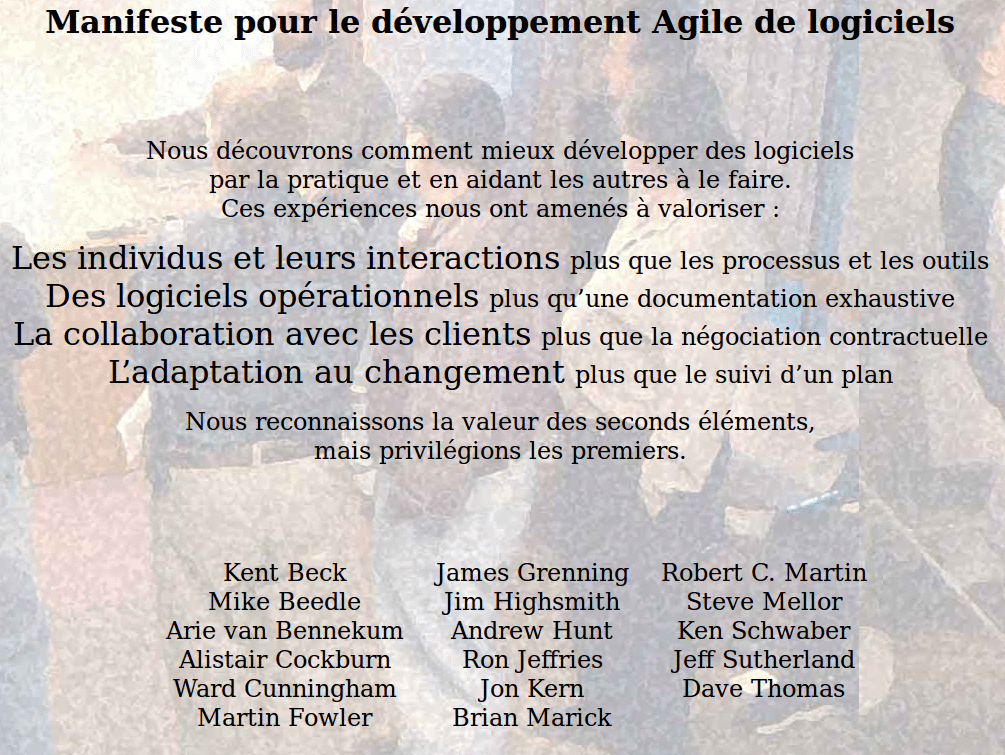
In 2001, seventeen developers gathered at a ski resort in Utah. Their conclusion was unanimous: traditional project management methods, rigid and process-centered, stifle creativity and exclude the human element from the heart of software creation. From this meeting was born the Agile Manifesto, much more than a simple methodological framework: a true philosophy that puts the individual, collaboration and adaptability back at the center of collective work.
Far from being a set of fixed rules, the Agile Manifesto embodies a humanist vision of project development. It resonates particularly with the challenges of inclusion and knowledge transmission: how do we build organizations where everyone can contribute, learn and grow, regardless of their background or origin?
The foundations of a human-centered approach
The Agile Manifesto rests on four fundamental values that question how we work together. These values don’t rank elements, but propose a preference: valuing more what serves people and the creation of real value.
Individuals and interactions over processes and tools
This first value affirms a strong conviction: it is people, with their skills, their creativity and their ability to communicate, who make a project succeed. Tools and processes are facilitators, not ends in themselves. This philosophy encourages self-organized teams where everyone’s voice counts, where different backgrounds become assets rather than obstacles.
This approach naturally fosters inclusion: it recognizes that diversity of profiles, experiences and perspectives enriches collective creation. A junior developer brings a fresh perspective, a person in career transition brings unsuspected cross-functional skills. Collective intelligence is built precisely in this mutual recognition and this ability to combine talents.
Working software over comprehensive documentation
The second value favors the creation of tangible value. This is not about rejecting all documentation, but about questioning its purpose: who does it really serve? The Agile Manifesto encourages focusing energy on what brings concrete utility to users.
This orientation toward pragmatism facilitates learning by doing. Rather than spending months theorizing, teams quickly produce functional versions, learn from their users, and adjust. This iterative approach is particularly relevant for supporting people in training or career transition: it allows skills to be acquired progressively, in real situations, with regular constructive feedback.
Customer collaboration over contract negotiation
The third pillar of the Manifesto: a relationship of trust and co-construction with those we work for. Instead of a fixed contractual relationship where everyone protects themselves behind clauses, agility proposes a partnership where the client and the team move forward together, adjust to each other, and share learnings.
This value resonates with the spirit of transmission: the client is no longer a distant party giving orders, but a partner who shares their business expertise, while the team brings its technical know-how. This reciprocity creates fertile ground for mutual learning and innovation.
Responding to change over following a plan
The fourth value acknowledges a reality often ignored by traditional methods: the world changes, needs change, and rigidly clinging to an initial plan becomes counterproductive. Agility does not reject planning, it makes it adaptive.
This flexibility is essential in an inclusive approach. It allows learning methods to be adjusted according to individual needs, work rhythms to be adapted, and people with varying levels of experience to be progressively integrated. The capacity for adaptation becomes a collective skill that strengthens the team’s resilience.
The twelve principles: a concrete implementation
The four values break down into twelve principles that guide daily action. These principles are not strict rules, but guidelines that adapt to each team’s specific context.
Among these principles, some resonate particularly with a humanist and inclusive vision of work:
- Continuous delivery of value encourages progressive learning and regular feedback, essential for supporting skill development.
- Welcoming change fosters adaptability, a crucial skill in a professional world in constant flux.
- Daily collaboration between all stakeholders creates an environment conducive to knowledge transmission.
- Self-organized teams empower everyone and value autonomy, factors of professional fulfillment.
- Regular reflection on improvement establishes a culture of continuous learning where error becomes a source of progress.
Beyond software development: a philosophy applicable to all fields
While the Agile Manifesto was born in the context of software development, its principles largely transcend this initial framework. Agility is now applied in many sectors: education, healthcare, manufacturing, services.
This universality is explained by the deeply human nature of agile values. Any organization seeking to foster collaboration, adaptability and value creation can draw inspiration from this philosophy. Concrete methods like Scrum or Kanban offer practical frameworks for embodying these principles daily.
The challenges of an inclusive agile transformation
Adopting agility is not just about applying techniques. It is a deep cultural transformation that can raise resistance, particularly in organizations accustomed to traditional hierarchical operations.
The success of an agile transformation rests on several factors:
Support and training are essential. Changing paradigms requires time, patience, and continuous support. Teams need to experiment, make mistakes, adjust. This phase of collective learning is valuable: it creates a shared culture and strengthens cohesion.
Transparency and communication help dispel fears and misunderstandings. Resistance to change is often legitimate: fear of losing one’s bearings, worry about one’s future role, doubt about one’s ability to adapt. Listening to these fears, taking them seriously, co-constructing solutions – that is what distinguishes an imposed transformation from an evolution chosen collectively.
Exemplary leadership plays a decisive role. Leaders and managers must embody agile values: accepting vulnerability, acknowledging they don’t have all the answers, trusting collective intelligence, valuing learning rather than punishing error.
Agility and shared governance: toward learning organizations
The spirit of the Agile Manifesto naturally connects with distributed governance approaches like holacracy or sociocracy. These organizational models share with agility the same conviction: the best decisions emerge from collective intelligence, not hierarchical authority.
In these organizations, everyone bears responsibility for their area of expertise, while contributing to the shared vision. Roles are fluid, evolving, in the service of the project rather than status. This fluidity facilitates the inclusion of diverse profiles and allows everyone to find their place according to their skills and aspirations.
Agile methods also offer tools for managing the tensions and conflicts inevitable in any collective work. Regular retrospectives, for example, create safe spaces to express difficulties, identify dysfunctions, and collectively seek solutions. This practice of shared reflection progressively builds a culture where vulnerability is accepted and kindness is cultivated.
Agility as a vector of inclusion and transmission
Beyond operational efficiency, adopting an agile approach can serve broader social goals. By valuing collaboration, continuous learning and adaptability, these methods create environments conducive to the inclusion of people with diverse backgrounds.
Agile teams work in short cycles with clear goals and frequent feedback. This structure particularly helps people in career transition or in training: they can progress in stages, regularly celebrate their advances, and adjust their path based on their discoveries. Error is no longer a failure but a normal step in learning.
The collective dimension of agility also facilitates the transmission of knowledge. In a self-organized team, the most experienced naturally share their knowledge, not out of hierarchical duty but out of collaborative necessity. Pair programming, collective code reviews, and practice-sharing workshops become so many opportunities to learn from one another.
This culture of transmission benefits everyone: seniors enrich their understanding by explaining, juniors quickly build up their skills, and the team progressively builds a shared knowledge base. This dynamic of mutual learning creates bonds, strengthens cohesion, and fights professional isolation.
Complementarity with other approaches
The Agile Manifesto does not oppose other methodologies but can be enriched by their contributions. The principles of Lean Management, for example, share with agility the same obsession with value and a desire to reduce waste. Combining these approaches allows for an even more refined ability to create value while preserving the human element.
Collective intelligence techniques, facilitation methods, and design thinking approaches complement the agile toolbox. What matters is not dogmatically applying a method, but cultivating a mindset: one of continuous improvement, listening, adaptability and kindness.
A mindset more than a method
The Agile Manifesto does not offer a miracle recipe. Rather, it outlines the contours of a philosophy of collective work, rooted in humanist values. Its successful adoption does not depend on the strict application of rituals or tools, but on the deep integration of its fundamental principles.
Being agile means accepting uncertainty and turning it into an opportunity. It means recognizing that we don’t know everything, that needs evolve, that the best ideas often emerge where we least expect them. It means creating spaces where everyone can contribute according to their strengths, learn from their weaknesses, grow alongside others.
This posture finds particular resonance in contexts where we seek to reduce exclusion and foster the emergence of talent, regardless of background. By putting people at the center, by valuing the diversity of approaches, by cultivating collective learning, agility becomes much more than a project management method: it becomes a lever for professional emancipation and the building of fairer, more effective organizations.
The path to agility is not linear. It requires perseverance, humility, and a constant desire to learn. But for teams and organizations that sincerely commit to it, it opens exciting perspectives: those of building together, with respect for everyone, projects that have meaning and create lasting value.