Understanding the dysfunctional roles that sabotage inclusion and discovering how individual responsibility and empathetic communication unleash collective potential
An Invisible Trap
Imagine an organization that has generously adopted shared governance. No more rigid hierarchy. No more distant boss imposing their decisions. All colleagues have an equal voice in decision-making. Theoretically, it’s democratic utopia.
And then, after a few months, something distorts. Meetings become invisible battlefields. One person feels “oppressed” by the others and positions themselves as a victim. Another “imposes their ideas” and plays the persecutor role. A third rushes to “save” everyone, proposing solutions without having really listened.
Power changes form, but not nature.
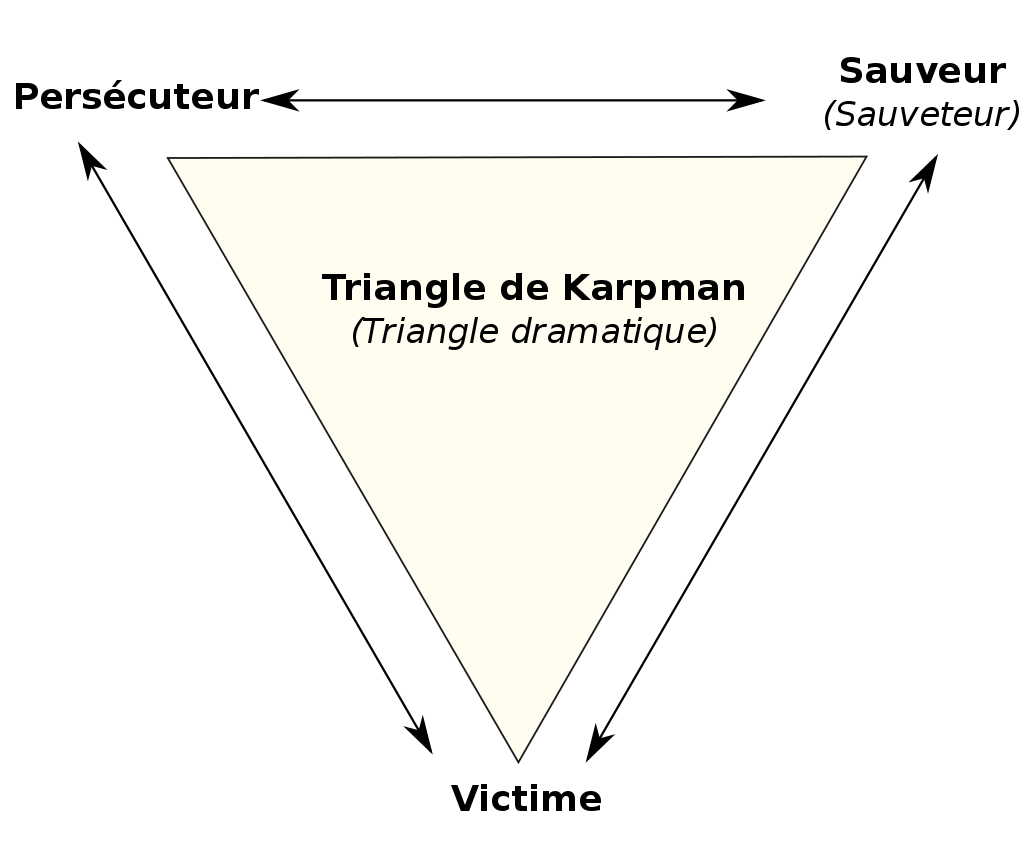
What happened? The involuntary emergence of the Karpman Triangle — a fundamental psychological model that shows how human groups create conflict dynamics even when formal structures disappear.
At 1Clusif, a humanist movement dedicated to inclusion and transmission, we know that understanding this triangle is not an academic curiosity. It is the key to building organizations where equality is not a slogan, but a lived reality.
What Is the Karpman Triangle? Beyond Simplification
The three roles and their deep psychology
The Karpman Triangle, identified by psychologist Stephen Karpman, describes three recurring interpersonal roles:
1. The Victim Do not confuse the psychological victim with a person who has actually suffered an injustice. The person in the victim role perceives themselves as powerless, oppressed, devoid of resources. Crucial distinction: they have internalized their powerlessness. They wait to be saved.
This is the person who says: “No one ever listens to me. My ideas don’t count. I can’t do anything against the majority.”
2. The Persecutor This is the person who positions themselves as the holder of power, reason, moral authority. They impose their ideas, they decide, they control. They can do it openly or, in democratic environments, more subtly: through rhetoric, through the expertise they wield, through their charisma.
This is the one who says: “We need to stop discussing. Here’s what needs to be done.” And who, unconsciously, crushes alternative voices.
3. The Rescuer This one plays a particularly deceptive role. They position themselves as the one who will “fix” the problem, bring the solution, resolve the conflict. Often in good faith. But in doing so, they keep the other two in their roles: the victim becomes dependent on rescue, the persecutor can continue because the rescuer absorbs the attention.
They continually propose processes to “sort things out,” they become the permanent mediator, they self-proclaim themselves guardian of collective values.
What makes this triangle truly problematic
Three key elements make the Karpman triangle particularly insidious in modern organizations:
1. The perpetual interchange of roles Individuals do not stay fixed in their roles. Within the same meeting, the victim can suddenly transform into a persecutor (“You never listened to me, and now I’m imposing MY vision”). The rescuer can become a victim (“I do everything and no one thanks me for it”). It’s an emotional carousel that creates permanent confusion.
2. The invisibility of the system Unlike formal hierarchy where power is clearly identifiable, the Karpman triangle operates in the shadows. People deny it. “No, that’s not it,” says the person playing the persecutor. “I’m just doing what’s best for everyone.”
3. Compatibility with progressive values This is particularly perverse: the triangle thrives all the more in humanist organizations. Why? Because the culture of kindness creates a space where roles are masked under generous intentions. The rescuer becomes a hero, the victim becomes “someone who needs support,” the persecutor becomes “someone passionate.”
The Karpman Triangle in Distributed Governances: Concrete Use Cases
Scenario 1: The Shared Governance Council
Imagine a startup that has adopted holacracy. During a circle meeting, a junior contributor proposes an innovative approach for a process. Immediately, a senior intervenes: “We tried that two years ago. It doesn’t work.”
Roles activated:
- The junior becomes the victim (“My voice is crushed by experience”)
- The senior plays the persecutor (“I know better”)
- A third party intervenes as rescuer (“Why not create a working group to explore the idea?”)
Result? The subject is diluted into a committee. The creative energy of innovation has dissipated. And everyone’s perception is reinforced: does the junior think their opinion really counts? The senior believes they protected the group. The rescuer feels useful.
Scenario 2: The Inclusion Paradox
A humanist organization launches an inclusion program to “give a voice to those who are not heard.” Paradoxically, this is the perfect occasion for the triangle to emerge.
Roles activated:
- The “forgotten minorities” become victims (this is their starting position)
- The former power holders become persecutors (even if they do nothing)
- The inclusion champions become rescuers (“We’re going to fix this”)
Result? A representation system that ultimately reproduces the same dynamic: there are the “rescued” on one side and the “rescuers” on the other. True inclusion, where everyone is responsible, never emerges.
Scenario 3: Collaborative Burn-out
A team adopts consensus decision-making. Praiseworthy intention. But here’s what really happens:
Roles activated:
- Those who don’t like the decision become victims (“Our voices didn’t count”)
- Those who pushed the decision become persecutors (“We imposed our vision”)
- The facilitators become rescuers (“Let’s launch a new round of discussions”)
Result? Endless meetings. Crushing collaborative fatigue. And paradoxically, worse decision-making because it is the result of exhaustion, not clarity.
Why Agile Methods Alone Are Not Enough
Why? Because the Karpman triangle does not operate at the level of processes. It operates at the level of unconscious psychological dynamics.
The lure of retrospectives
An agile retrospective asks: “What did we do well? What did we do badly? What are we going to improve?”
But imagine a victim of the triangle participating in this retrospective. Will they say: “I played the victim role and I really sabotaged our collaboration”? No. They will say: “I didn’t feel listened to.”
Will they recognize their role in maintaining the triangle? Rarely.
Agile processes optimize the surface, not the core.
The illusion of empowerment
Agile methods talk a lot about “empowerment.” But what does this really mean within the triangle?
If I accept “my responsibility” as a victim, am I really responsible, or am I simply being made to feel guilty? If the persecutor accepts “their responsibility,” will they really change their behavior, or will they simply justify it better?
Empowerment must be anchored in something deeper: a shared purpose and an awareness of one’s own functioning.
Nonviolent Communication: The Path Out
If agile methods alone are not enough, what really works?
One answer lies in Marshall Rosenberg’s Nonviolent Communication (NVC), a deeply humanist model that diametrically opposes the dynamics of the Karpman triangle.
The four components of NVC
NVC rests on four simple but profound movements:
1. Observation without judgment Instead of saying “You oppress me,” I say: “When you spoke during the meeting, I didn’t intervene.”
Why does this break the triangle? Because I abandon the victim role. I stop positioning myself as oppressed. I simply describe objective reality.
2. Identification of the feeling Instead of blaming, I reveal what I feel: “I feel frustrated.”
Why is this radical? Because frustration is my responsibility, not the other person’s. They didn’t “make” me frustrated. My frustration emerges from my own unmet needs.
3. Expression of needs Instead of accusing, I clarify what I lack: “I need my ideas to be heard and considered seriously.”
Why does this disarm the persecutor and the rescuer? Because I take responsibility for my own needs. I’m not asking to be saved. I clarify my need and invite the other to collaborate.
4. Clear request Instead of lamenting, I ask specifically: “Could you give me 10 minutes to fully present my idea before criticizing it?”
Why does this change everything? Because I move from the victim role waiting to be saved, to the role of a responsible actor, making a clear request.
Read also: Marshall Rosenberg’s Nonviolent Communication — The pillar of shared governances
How NVC dismantles the triangle
Here is the genius of NVC: it makes maintaining the triangle impossible.
If everyone uses NVC, here is what becomes impossible:
- No victims (we express our needs, we don’t lament)
- No persecutors (we listen to others’ needs instead of imposing)
- No rescuers (we invite the other to be responsible for their own solutions)
Instead, there is an authentic dialogue between people responsible for their own needs and eager to collaborate.
Learn more: Empathetic listening and Nonviolent Communication
Beyond NVC: Purpose as a Compass
But NVC, even powerful, is not sufficient if it is not anchored in something broader: a clear shared purpose.
Why? Because it is possible to be “nonviolent” while remaining dysfunctional. One can express their needs in an empathetic and civilized manner… while serving a personal cause rather than a collective mission.
How purpose interrupts the triangle
Imagine an organization where everyone truly knows and embodies the collective purpose.
Now, when the triangle begins to emerge:
- The victim asks: “Does this role serve our purpose?”
- The persecutor asks: “Do my actions align our collective with our mission?”
- The rescuer asks: “Am I really useful, or am I maintaining dependency?”
And in each case, the answer is no. The role collapses.
Why? Because the triangle thrives in a moral and collective void. But when there is a clear direction, a visceral purpose, the dysfunctional roles become visible for what they are: distractions from the mission.
Discover: Humanism in Business — Placing human beings at the heart of your decisions
Building a Genuinely Distributed Governance: Beyond the Triangle
Here are the concrete steps to create a distributed governance that overcomes the Karpman triangle:
1. Clarify and embody the purpose
As we explored in our previous articles, purpose must be much more than a statement. It must be a living reality, constantly referenced, constantly verified.
Guiding question in every interaction: “Does this serve our purpose?”
2. Train in Nonviolent Communication
Not as an optional skill, but as a collective language. Successful humanist organizations invest massively in this.
Why? Because NVC is not just a communication technique. It is a philosophy of individual responsibility — everyone is responsible for their own needs, their own feelings, their own requests.
3. Create radical transparency
If information circulates freely, the triangle has much less ground to thrive on. Victims cannot feel “excluded from information.” Persecutors cannot impose their vision due to lack of data. Rescuers must confront reality rather than fantasies about what “is really happening.”
4. Value discomfort and dissent
The triangle loves false consensus. It loves appearances of harmony masking dysfunction.
True humanist organizations celebrate productive dissent. They ask: “Who has a concern?” rather than “Does everyone agree?”
The difference? Enormous. The first invites power. The second invites obedience.
Read also: Principles of shared governance — Transparency, trust and responsibility
5. Structuring without hierarchy is not removing structure
Sociocracy, holacracy and other distributed models propose a real structure — clear roles, defined responsibilities, transparent processes.
This is not a hierarchy, but it is a structure.
And this structure is crucial to avoid the chaos where the triangle thrives.
Learn more: Sociocracy — Redefining governance for optimized functioning
Conclusion: The Triangle as a Mirror
The Karpman triangle, ultimately, is not a curse. It is a mirror.
It shows us where we stand as a collective. It shows us where we still have unresolved fears, unexpressed needs, unclear missions.
Successful distributed governances are not those that deny the triangle. They are those that consciously recognize and overcome it, by deploying three powerful tools:
- A crystal-clear purpose that transcends power games
- Humanist communication (NVC) that makes needs visible and honest
- Individual responsibility where everyone agrees to see themselves clearly
At 1Clusif, we believe that is what true inclusion is. Not the absence of structure or power. But the presence of responsible people, communicating with honesty, guided by a collective mission that transcends them.
Is your organization ready to look its mirror in the face?
Additional Resources on 1Clusif
- Nonviolent Communication — The pillar of shared governances — Understanding the framework that disarms the triangle
- The 5 key steps for effective Nonviolent Communication — Practicing concretely
- Empathetic listening — Essential to NVC — The foundation of humanist dialogue
- Principles of shared governance — Understanding the broader framework
- Sociocracy: Redefining governance — A structured model that prevents the traps
- Humanism in Business — The fundamental principles
- 1Clusif — Mission of inclusion and transmission