
How holacracy really redistributes power (and why this redistribution can be more subtle — and more perverse — than we think)
The Word “Revolutionary” Is Misleading
Here’s what happens when people talk about holacracy: the word “revolutionary” comes up immediately.
“It’s revolutionary! It’s the future! It’s beyond hierarchy!”
But here is the truth: Holacracy is not revolutionary. It’s a redistribution of traditional power.
It doesn’t eliminate it. It redraws it.
And this subtlety? It’s the secret that changes our whole understanding.
At 1Clusif, we believe in clarity about governance models. Not the hype. Not the slogan. Clarity.
So here is holacracy: as it really is. Its real advantages. Its real traps. And why it can be better than a hierarchy without being authentically humanist.
Holacracy
Brian Robertson’s invention
Holacracy was created by Brian Robertson in 2007 after a simple question: “How can I eliminate organizational politics?”
It’s an interesting question. Not “How can I make people more engaged?” But “How can I eliminate politics?”
Politics, according to Robertson, is the hidden power game. The boss’s favorites. Unofficial alliances. People navigating the corridors to gain influence.
Robertson’s solution: Crystallize power in a role architecture rather than in human relationships.
If power lives in roles, not in people, then politics disappears.
It’s brilliant. It’s also fundamentally lacking in understanding of the fact that human beings will always create politics, regardless of the structure.
The 3 Key Elements
1. Circles (The Architecture)
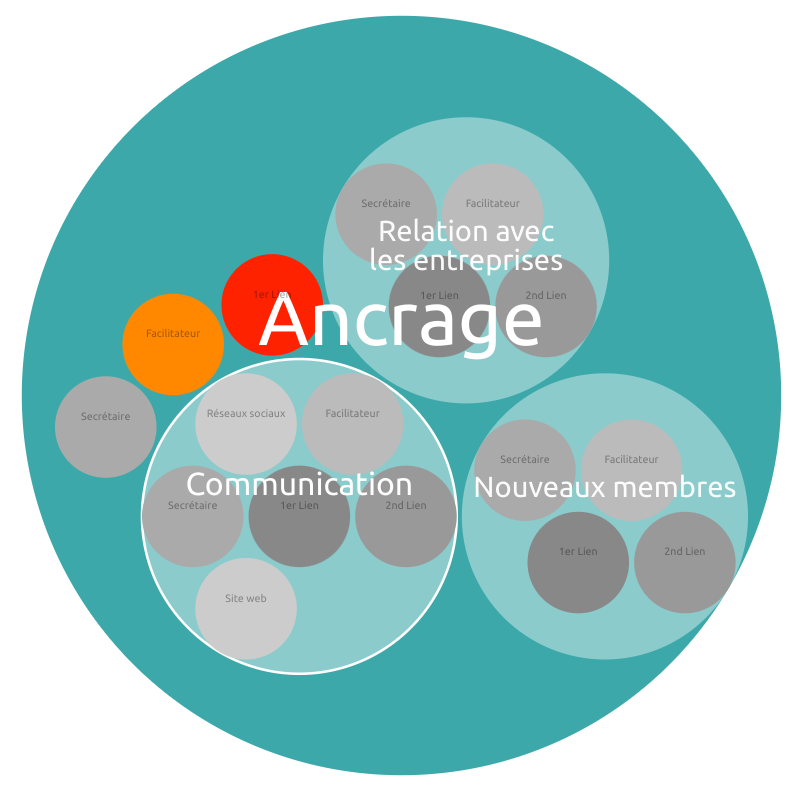
A holacracy organization is made up of nested circles.
For example:
General Circle (the whole org)
Product Circle
Operations Circle
Engineering Sub-circle
Support Sub-circle
Each circle has a specific purpose — not a vague job like “Department X.”
The circle’s purpose is precise. “Ensure our product meets customer needs.” “Maintain the IT infrastructure.”
Impact: Maximum clarity on why the circle exists.
2. Roles (Crystallized Power)
Inside each circle, there are no “positions” or “titles.” There are roles.
A role has:
- A name (“Lead Engineering,” “Facilitator”)
- A purpose (“Ensure technical quality”)
- Domains (“Software architecture”)
- Accountabilities (“Issue architectural decisions”)
A person can hold several roles in different circles. This creates a fluidity hierarchy doesn’t have.
Impact: Power distributed based on clarity, not on relationships.
3. Governance Meetings (Actualization)
This is where it becomes structured. There are regular meetings where roles are:
- Created or removed
- Redefined or modified
- Assigned to new people
These meetings follow a rigid process. No free-flowing discussion. A process.
Impact: The structure is constantly updated to reflect reality, not fixed.
The Hidden Concept: “Tensions”
Here is where it gets psychologically interesting.
At the base of holacracy is the concept of tension.
A tension is the gap between what is and what could be.
Example: “I see a problem with our process. It’s not my role to fix it, but I have a tension.”
In holacracy, tensions are invited. They are not complaints. They are data. Signals that something needs to change.
Why this is brilliant
A tension creates an opportunity to see what isn’t working. Not through complaint, but through clear observation.
Someone says “We have a tension: decisions take too long.”
The group processes this tension structurally. Maybe a new role is created. Maybe a process is removed.
Impact: The organization self-updates. It doesn’t wait for someone to “complain loudly enough.”
Why this is problematic
The word “tension” is psychologically neutral. It sounds good.
But here’s the trap: by making tensions “neutral,” we can also make the real emotions underneath invisible.
Someone says “I have a tension: I don’t feel heard.”
The holacracy response: “What’s the structural tension here? How can we modify a role or a circle?”
But maybe it’s not a structural problem. Maybe it’s a relational problem. Someone doesn’t feel seen.
Holacracy has no language for that. It only has the language of “tension” and “structure.”
The Advantages of Holacracy
1. Extreme Clarity
I can’t overstate this: a good implementation of holacracy creates crystal-clear clarity.
When you arrive in the morning, you know:
- Which roles you hold
- Which roles others hold
- What your exact decision-making power is
- Where your responsibilities end and others’ begin
Compared to a traditional organization where everything is ambiguous? It’s night and day.
Impact on people: Reduced anxiety. Less political game-playing. Energy toward real work, not toward political navigation.
2. Organizational Agility
Because roles are not “permanent positions,” the organization can adapt quickly.
A new priority emerges? A new role is created. An old priority disappears? The role is removed.
No political debate about “who’s going to carry this new role?” It’s a structural decision.
Impact: Holacracy organizations can pivot quickly.
3. No Sacred Authority
In traditional hierarchies, there is a sacred “chain of command.” You report to X, who reports to Y.
In holacracy, there’s no “reporting to.” There are just roles. You hold the Lead Engineering role. Another person holds the Director role. But you both hold different roles, not a relational hierarchy.
Impact: Less “who reports to whom.”
4. People’s Involvement
When people clearly understand their power and their responsibilities, they engage more.
“My role matters. My decisions matter. I’m not just an executor.”
Impact: Higher engagement than in a soft hierarchy.
Also read: Nonviolent Communication — What Holacracy Is Missing
The Pitfalls
Pitfall 1: “Clarity” Can Be a Prison
Yes, holacracy is clear. But clarity can be oppressive.
Here’s a real example. Imagine an Engineering circle. The “Software Architect” role has a very clear domain: “Software architecture.” The accountabilities are stark: “Make architectural decisions.”
Now imagine something important emerges that is not explicitly within that domain. It’s on the border. It’s ambiguous.
The holacracy response? “That’s not your role. Go to a governance meeting to clarify.”
But this thing is urgent and the governance meeting is only on Thursday.
Holacracy has stolen your agility through its own clarity.
Pitfall 2: New Invisible Hierarchies
Holacracy says “No hierarchy.” But human beings always create hierarchy.
Someone who speaks well, who understands the processes, who seems competent? They dominate meetings. Not formally. But psychologically.
A quiet, reserved person, even a very competent one? They can be overwhelmed.
And here’s the trap: because there’s no formal hierarchy, the informal hierarchy becomes invisible. No one can name it.
At least in a traditional hierarchy, we know the boss is the boss. In holacracy, the boss is invisible and therefore more powerful.
Pitfall 3: Governance Meetings Become Perpetual
I’ll be direct: holacracy governance meetings are work.
They follow a rigid process: “What tensions do you have?” “Let’s process this tension.” “Next tension.”
It’s efficient. But it’s exhausting. And if the team constantly has tensions, you live in governance meetings.
That’s a real cost: meeting-induced burnout.
Pitfall 4: Roles Can Become Cages
A role gives you clarity. But it also confines you.
“That’s not my role” becomes a tool of protection. People stay in their boxes.
Innovation that crosses roles? That requires a governance meeting to “clarify.” Creative improvisation that transcends domains? It’s seen as organizational fuzziness.
Consequence: Holacracy can kill impulsive creativity.
Pitfall 5: Holacracy Assumes Clarity Is Neutral
Here is the biggest trap: holacracy assumes that if we clarify roles, we eliminate politics.
But clarity itself is political.
Who decides the role’s domain? Who decides the accountabilities? These decisions reflect hidden power — a worldview of those who wrote the structure.
And this worldview, once crystallized into roles, becomes hard to question.
For example, if the “Facilitator” role has the accountability “Ensure meetings move forward,” this reflects an assumption: that meetings that move forward are good. But maybe in a humanist context, we want meetings that really listen, even if it’s slow?
The holacracy structure has already decided for us.
Holacracy’s “False Inclusion”
Holacracy creates formal inclusion, not true inclusion.
What it really offers
Formally:
- Everyone can participate in meetings
- Everyone can raise tensions
- Everyone holding a role has power within that role
That’s more inclusive than a hierarchy, yes.
But here’s what it doesn’t do
It doesn’t honor minority voices who don’t speak up.
In holacracy, if you have a tension, you raise it. But if you’re someone who doesn’t speak in public, you stay silent.
Holacracy has the language of “tension” but not the language of deep listening.
Compared to sociocracy, which explicitly asks “Do you have an objection?”, holacracy implicitly says “If you have something to say, say it.” The burden is on you to speak.
And psychologically, that’s very different.
Also read: Holacracy vs Sociocracy — Real Philosophical Differences
When Holacracy Really Works
Favorable Contexts
1. Technology organizations / agile startups
Holacracy shines when:
- Change is constant
- Role clarity is a gain (not a creative loss)
- The team is already relatively homogeneous and confident
Example: A software startup that needs to pivot quickly. Holacracy creates the clarity and agility you need.
2. Organizations with a tech/engineering culture
Engineers like clear structures. They think in terms of systems. Holacracy resonates with them.
3. Organizations with no pre-existing political baggage
If you’re starting a new organization, holacracy can be wonderful. There are no old political games to unlearn.
Unfavorable Contexts
1. Creative / artistic organizations
Artists and creatives need fuzziness. Space for improvisation. Holacracy can crush that.
2. Organizations with organizational trauma
If the team has suffered from manipulation or hidden politics, holacracy will increase distrust at first. (Though it may eventually reduce it.)
3. Organizations where humanist inclusion is a real priority
If your mission is the inclusion of marginalized people, holacracy alone is insufficient. It needs NVC + humanist purpose.
4. Organizations in constant emergency
Holacracy governance meetings take time. If you’re in permanent crisis, that’s too high a cost.
The Zappos Case: The Unheeded Warning
Zappos adopted holacracy in 2013. For two years, it was wonderful: clarity, agility, increased engagement.
Then something started to change.
People were leaving. Notably the creatives. People who loved imprecision and improvisation.
Why? Because the holacracy structure — however clear — had crushed something human.
What went unsaid but happened: Holacracy had replaced “political chaos” with “rigid mechanics.”
People had traded one problem for another.
Today, Zappos continues with a “softened” version of holacracy. Less rigid. More room for humanity.
Lesson: Holacracy requires a humanist temperament to avoid becoming a machine.
Holacracy + NVC
Holacracy focuses on structure. It’s brilliant for that.
But it completely lacks relational language.
When two people in conflict within a holacracy organization meet, they have:
- Clear roles
- Clear domains
- A governance meeting process
But they don’t have: a common language to talk about their feelings, needs and concerns.
This is where Nonviolent Communication becomes critical.
When you combine:
- Holacracy (clear structure)
- NVC (language of equality and empathy)
Something wonderful emerges: an organization that is clear and human.
Go deeper: Nonviolent Communication — The Language Holacracy Needs
Realistic Implementation: Pitfalls to Avoid
Mistake 1: Believing Holacracy “Fixes” Politics
No. It restructures it. If you launch holacracy in a toxic political organization, you’ll just get a political holacracy (where politics is played out through “tensions” and meetings).
Solution: Start with culture. Then add the holacracy structure.
Mistake 2: Implementing Without NVC Training
If people understand holacracy but not NVC, governance meetings become polite battlefields.
Solution: Simultaneous holacracy + NVC training.
Mistake 3: Assuming Everything Will Be Clear
No. There will always be ambiguity. The holacracy structure creates the maximum possible clarity — not total clarity.
Accept that governance meetings will be a constant.
Solution: Budget time for governance meetings.
Mistake 4: Neglecting Quiet Voices
Because holacracy invites “tensions” but doesn’t actively solicit them, quiet people can remain invisible.
Solution: Actively invite quiet voices. “Does anyone have a tension they’re hesitant to share?”
Why 1Clusif Sees Holacracy as a Tool, Not a Solution
At 1Clusif, we value inclusion and transmission.
Holacracy is a brilliant tool for creating clarity and agility. But it’s not enough to create a truly humanist culture.
Why?
Because it has no language for emotion, vulnerability, and deep learning.
It can create an organization where roles are clear and decisions are fast. But not an organization where people feel seen, where minority voices are actively invited, where transmission emerges naturally.
For that, you need:
- Clear structure (holacracy)
- Language of equality (NVC)
- Crystal-clear humanist purpose (why we exist)
All three together? That’s a humanist organization.
Also read: Amplified Governance — Beyond Simplistic Sharing
Conclusion: Not Revolutionary, But Useful
Holacracy is not revolutionary.
It’s an intelligent redistribution of traditional power. It makes it explicit and more fluid. But it doesn’t eliminate it.
And that’s OK. We’re not seeking a perfect organization. We’re seeking an organization better than hierarchy.
Holacracy does that. It creates greater clarity, agility and participation.
But it doesn’t create humanity. It doesn’t create connection. It doesn’t create deep inclusion.
For that, you must combine it with other elements: NVC, humanist purpose, and a culture of deep respect.
If you do this — holacracy + NVC + humanist purpose — you create something rare: an organization that is both clear and human.
Are you ready to see holacracy for what it really is: not a complete solution, but a brilliant piece of a bigger puzzle?
Additional Resources on 1Clusif
- Nonviolent Communication — What Holacracy Is Missing — The critical language
- Holacracy vs Sociocracy — Real Philosophical Differences — Understand the broader context
- Sociocracy — An Alternative with More Humanity — The inclusion-based approach
- 5 Models of Distributed Governance — See where holacracy fits
- The Karpman Triangle — Psychological Traps Even in Holacracy — What sabotages the structure
- Amplified Governance — Beyond Limited Power — A broader vision
- Humanism in Business — The values that should guide holacracy