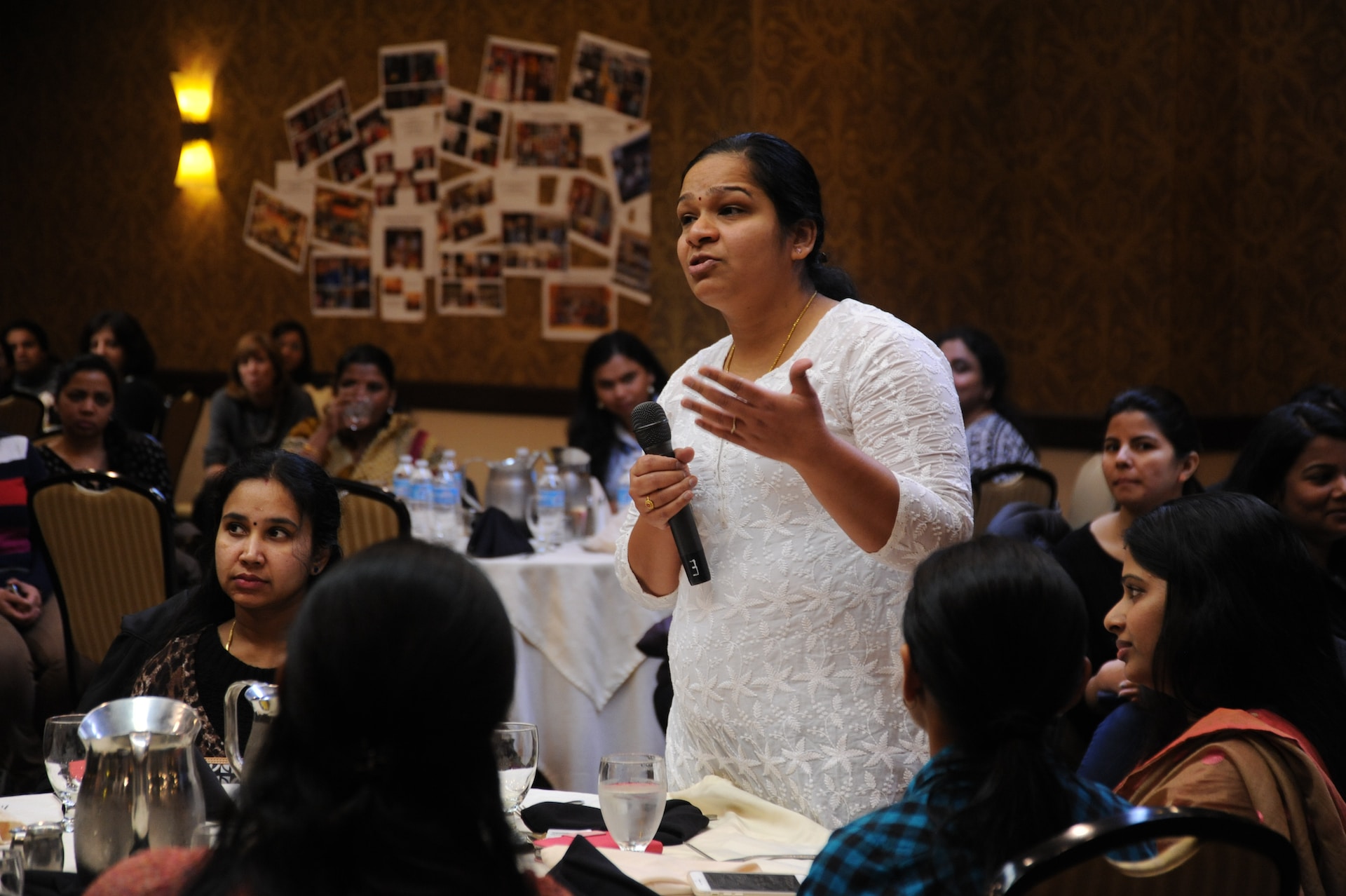
Photo by Wonderlane on Unsplash
In a professional world where exclusion often arises from misunderstandings and breakdowns in dialogue, the quality of our exchanges becomes a fundamental issue. How do we create spaces where everyone can fully express themselves, without fear of judgment? How do we turn our organizations into places of authentic inclusion? Nonviolent Communication (NVC), developed by psychologist Marshall Rosenberg in the 1960s, offers much more than a simple technique: it proposes a relational philosophy that resonates deeply with the challenges of collaboration and inclusion we face today.
An approach that goes beyond simple technique
NVC is not a rigid protocol to apply mechanically. It is above all a stance, a way of being in relationship that recognizes the humanity of every person. It rests on a conviction: behind every behavior, even the most difficult, lies a legitimate human need seeking to be expressed. This perspective radically transforms how we approach conflicts and differences. In professional contexts, particularly in diverse teams, this approach becomes a true lever for inclusion. It allows us to move beyond the cultural, generational or hierarchical barriers that sometimes fragment our collectives. Where traditional modes of communication can exclude certain voices, NVC creates a level playing field where every perspective can be heard.
The four pillars of Nonviolent Communication
Observation: seeing without interpreting
The first principle of NVC consists of distinguishing what is objectively observable from our subjective interpretations. In a professional environment, this distinction is crucial. Saying “you’re never available” is a judgment-laden interpretation. Observing “you haven’t responded to the last three messages I sent you this week” instead opens up a constructive dialogue. This ability to observe without judgment directly connects with the values carried in shared governance approaches, where transparency and clarity of exchanges allow for the equitable participation of all members.
Expressing feelings: recognizing one’s vulnerability
Expressing your feelings in a professional setting may seem counter-intuitive, even risky. Yet it is precisely this emotional authenticity that creates human connection. When we dare to say “I feel frustrated” or “I feel worried,” we step out of the professional mask to reveal our common humanity. This shared vulnerability is at the heart of what makes collectives strong. It allows us to move beyond power dynamics to create relationships based on mutual trust. By naming our emotions, we invite the other person to understand our inner experience rather than defend themselves against our accusations.
Identifying needs: understanding what drives us
Behind every feeling lies a universal need: the need for recognition, autonomy, contribution, security, meaning… These needs are what fundamentally connect us to one another, beyond our differences in background, age, culture or hierarchical position. Identifying and expressing our needs allows us to move beyond fixed strategies to explore new possibilities together. In the context of professional co-development, this ability to articulate our real needs facilitates the emergence of creative solutions tailored to everyone.
Formulating clear requests: inviting cooperation
A request differs from a demand in the freedom it leaves the other person to respond. It is specific, achievable and positively phrased. Rather than “stop interrupting me,” we can ask “would you be willing to let me finish before sharing your point of view?” This clarity in requests is essential in all collective work. It connects with collective intelligence practices where the precision of mutual expectations allows for smooth coordination and an equitable distribution of responsibilities.
NVC as a Tool for Inclusion and Transmission
Beyond its individual application, Nonviolent Communication profoundly transforms organizational culture. It creates environments where traditionally marginalized people more easily find their place. When we value the authentic expression of needs rather than conformity to implicit norms, we open the door to true diversity of thought and experience. This approach naturally fits into a process of authentic inclusion, where it is not just about inviting different people to the table, but about creating the conditions for every voice to truly express itself and be heard. In this sense, it connects with the principles of sociocracy, where every objection is considered a valuable contribution to the collective decision.
Empathetic Listening: The Other Side of NVC
If knowing how to express oneself with authenticity is fundamental, empathetic listening is the other essential pillar of NVC. It is not passive listening or simply waiting for our turn to speak. Empathetic listening requires total presence, a sincere desire to understand the other person’s world without immediately seeking to advise, judge or solve. This quality of listening is particularly valuable in contexts of diversity. It allows us to cross cultural or generational barriers by creating a space where everyone’s experience can be fully welcomed. In mentoring and management professions, this skill becomes a true vector of organizational transformation.
From Theory to Practice: A Path of Continuous Learning
Mastering Nonviolent Communication requires much more than simply knowing its four components. It is a path of personal transformation that requires practice, patience and self-kindness. Our usual reflexes of judgment, defense or interpretation are deeply rooted; transforming them takes time. This is why learning NVC benefits from being part of a collective process. Regular practices in groups, shared feedback from experience, and peer support create an environment conducive to experimentation and refinement. This transmission through collective practice embodies the very spirit of collaborative learning.
NVC and Humanist Governance: A Natural Convergence
Nonviolent Communication finds a particular resonance in shared governance models. When power is distributed and every voice counts in collective decisions, the quality of communication becomes decisive. NVC then provides the language and practices that allow us to navigate the complexity of multiple needs without falling into the traps of domination or unsatisfying compromise. In these contexts, NVC becomes much more than a conflict-resolution tool: it structures the very way the collective thinks, decides and acts together. It allows tensions to be turned into opportunities for innovation, disagreements into deep mutual understanding.
Toward a Culture of Shared Responsibility
One of the deepest effects of practicing NVC is the development of a culture of responsibility. When we learn to express our needs rather than accuse, when we listen with empathy rather than defend ourselves, we create an environment where everyone can fully own their choices and their consequences. This shared responsibility is essential in organizations seeking to transform themselves to become more inclusive and more adaptable. It allows us to move beyond logics of victimhood or guilt to build together solutions that honor everyone’s needs.
A Path of Hope and Transformation
In a professional world marked by fractures and exclusions, Nonviolent Communication reminds us of a fundamental truth: we all need each other, and our fundamental needs are more similar than different. By giving us the means to communicate with authenticity and empathy, it opens the way to richer collaborations and truly inclusive organizations. This is not an easy path. It requires courage to abandon our habits of judgment and defense. It requires perseverance to maintain this quality of presence even in difficulty. But it is a deeply human path, one that allows us to rediscover our innate capacity to connect with others in respect and kindness. It is an essential skill for anyone who aspires to take part in building more human, more just and more creative organizations.