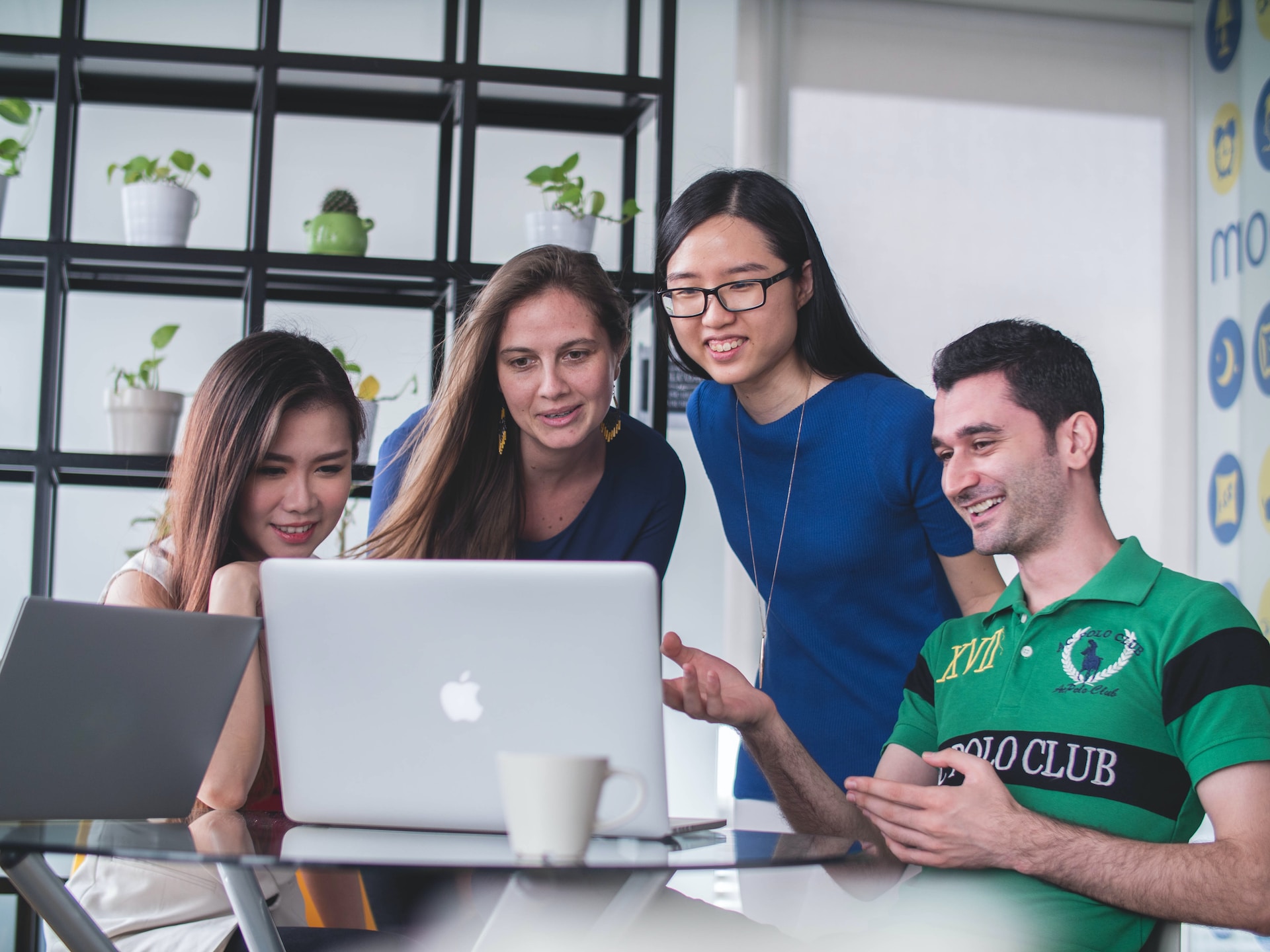
Photo by Mimi Thian on Unsplash
Co-development is not simply a method of collective work. It is a form of transmission where every member becomes both learner and contributor, where individual experiences turn into collective intelligence. But for this magic to happen, the conditions must be created: a group dynamic that values every voice, fosters mutual learning, and allows everyone to adapt to changing challenges. The reality is more nuanced than ready-made recipes: optimizing a group dynamic means understanding that every collective is unique, that tensions should not be avoided but rather transformed into levers of evolution.
Group dynamics: much more than a simple matter of communication
When we talk about optimizing the dynamics of a co-development group, we often imagine checklists: clarify goals, communicate more, listen actively. These elements are necessary, certainly, but insufficient.
The real dynamic of a group rests on something deeper: the collective’s capacity to adapt together. This means not only learning new skills, but also being able to unlearn habits that no longer work, to modify our behaviors in the face of obstacles, to bounce back after a failure.
This is precisely what the Adaptation Coefficient measures at the organizational level: a team’s ability to effectively modify its behaviors, cognitive approaches and emotional balance in response to change. A high-performing co-development group is not one that follows the plan to the letter, but one that knows how to pivot, reinvent itself, and learn collectively.
The four pillars for building an inclusive, adaptable dynamic
1. Clear goals, but revisited together
Yes, goals must be clear. But what really transforms a team is the ability to revisit them collectively. When goals are set in stone, when only leaders define them, you lose a valuable opportunity: the one where every group member contributes to redefining the direction.
Equality by nature does not mean everyone has the same role, but that everyone has an equal voice in defining the direction. It is this egalitarian participation that creates true engagement.
2. Open communication, grounded in vulnerability
Communication is only effective if it creates a space where everyone can express their doubts, their fears, their “crazy” ideas without fear of judgment. But this vulnerability cannot be improvised. It requires deliberate intention: creating an environment where it is safer to share concerns than to hide them.
This means group leaders must lead by example, sharing their own uncertainties. It is a matter of collective responsibility.
3. Diversity as a vector of adaptation
A homogeneous group will think homogeneously. This is a major risk for organizational adaptation. When you bring together different experiences, perspectives, origins, ages, and ways of thinking, you naturally create a greater capacity to see problems from different angles.
But valuing diversity is not just a box to check. It is daily work of active inclusion: making sure minority voices are heard, that introverted people or those from marginalized groups are not crushed by the majority.
4. The feedback loop: learning together from reality
Regular feedback sessions (also called retrospectives in an agile context) are not an administrative luxury. It is the moment when the group looks at itself in the mirror and collectively decides how to evolve.
These moments are particularly powerful when structured to explore: What have we learned? What blocked us? How are we adapting? Rather than simply drawing up a list of problems.
Pitfalls to Avoid: Permanent Vigilance
Unequal participation: when one voice dominates the others
This is an insidious problem. A few members dominate the discussions, others gradually fade away. The dynamic deteriorates without anyone always being able to point to the exact moment it changed.
The solution? Active vigilance. The group facilitator must create moments where silent voices are explicitly invited to speak. “Jean, we haven’t heard from you on this topic, what do you think?” This seems simple, but it is deeply transformative.
The group’s silent dysfunction
Sometimes groups appear to function but are disintegrating from the inside. Cliques form. Some feel excluded. Trust quietly cracks.
This is why you must cultivate an ability to see these weak signals: absences that accumulate, a decline in the quality of contributions, a certain fatigue in the exchanges. Collective responsibility means everyone has the right and the duty to name these dysfunctions.
The loss of motivation: when everyone’s voice has no impact
Nothing is more demotivating than participating in a group where your ideas disappear into thin air. If you propose suggestions and nothing comes of them, if your concerns are never addressed, you will quickly lose your engagement.
An adaptable group closes the loop: your ideas are heard, tested, rejected or adopted, but you always know why. This transparency maintains motivation even in the case of disagreement.
Creative tension: turning conflicts into learning
Conflicts are not a sign of a broken dynamic. They are a sign of a living dynamic.
A group where no one challenges anything is a group that stagnates. Conversely, the best co-development groups are those that know how to express disagreements, explore different perspectives without anyone trying to crush the others.
This requires a specific skill: the ability to separate the person from the problem. Disagreeing on an approach does not mean rejecting the person. The entrepreneurial spirit precisely encourages this communicational risk-taking: daring to say “I disagree and here’s why.”
When the group’s adaptation becomes everyone’s adaptation
An interesting phenomenon occurs when you truly cultivate collective adaptability: every group member naturally develops their own Adaptation Coefficient. Why? Because by living in an environment where change is normal, where experimentation is encouraged, and where mistakes are data rather than catastrophes, you progressively internalize this adaptable posture.
Co-development then becomes a true laboratory of mutual learning where everyone strengthens their ability to navigate a world in perpetual transformation.
Beyond methods: a philosophy
Optimizing a group dynamic is not a project with an end date. It is ongoing work of readjustment, attention, creativity in managing tensions, and deep listening.
The values that support this work – equality, transmission, shared responsibility, a spirit of experimentation – are not abstract theoretical principles. They must be embodied in every interaction, every decision, every moment of discomfort.
When these conditions are present, something magical happens: the group becomes more than the sum of its parts. Individuals grow, ideas cross-pollinate and mutate, and the organization itself becomes resilient in the face of unpredictable challenges.
To Go Further
The question of organizational adaptation is at the heart of contemporary challenges. If you want to further explore how to cultivate this capacity in your teams, discover the Adaptation Coefficient, the vital skill of the 21st century – a deep reflection on what it really means to be adaptable in our time.
Co-development remains one of the best strategies for developing this skill collectively. Because no one really adapts alone.